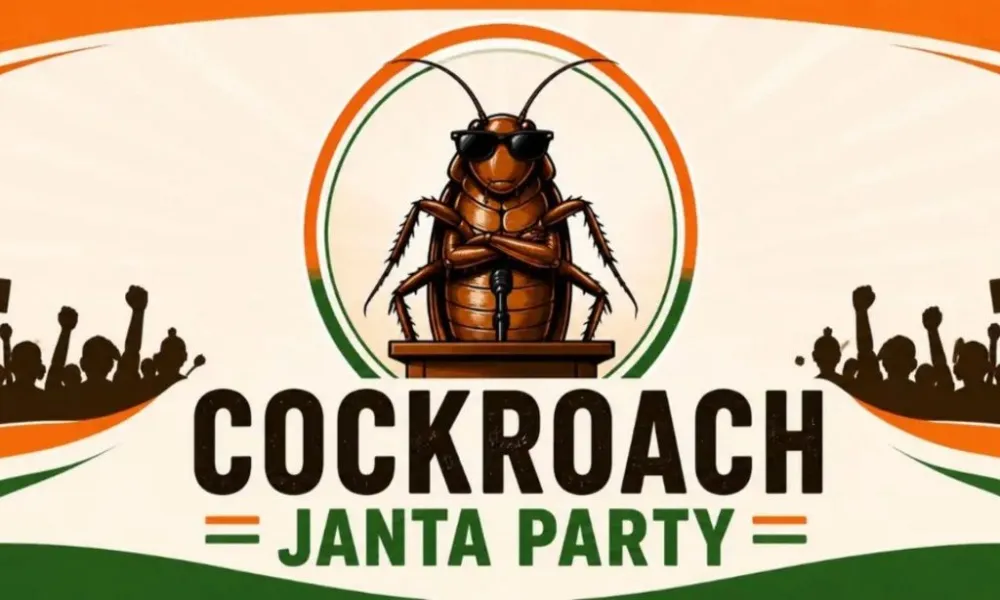

An online political parody has transformed into a viral movement reflecting the frustrations of India’s Gen Z, disrupting the country’s political discourse within five days of its launch. The Cockroach Janta Party, an unofficial movement rooted in political satire, has amassed over 16 million followers on Instagram. The digital surge places its social media following ahead of the nine million followers maintained by Prime Minister Narendra Modi’s ruling Bharatiya Janata Party, an institution that claims to be the largest political organisation in the world.
The satirical movement was triggered by remarks made by the Supreme Court of India Justice Suriya Kant during a public hearing. Kant compared unemployed youth who lack professional placement to parasites and cockroaches that attack the system, noting that some become journalists, social media influencers or activists who target public institutions.
What has Hindu-Muslim politics actually given to this country or its youth besides division, distraction, and lost opportunities?
— Cockroach Janta Party (@CJP_2029) May 20, 2026
While the world moves ahead with AI, innovation, and jobs, how long are we going to stay trapped in the same old politics? : @abhijeet_dipke pic.twitter.com/z2aNBnsdcw
Kant later clarified his remarks, stating that his comments were aimed specifically at individuals holding fraudulent degrees rather than the nation's youth, whom he described as pillars of a developed India. However, the statement provoked significant backlash online from young citizens facing high unemployment, inflation and social divisions following 12 years of governance under the Hindu nationalist administration.
Strategic creation and membership criteria
The movement was launched by Abhijeet Dipke, a 30-year-old political communication strategist and student at Boston University, following an initial satirical post on the social media platform X. Dipke established the online presence of the movement within 24 hours, utilizing artificial intelligence tools such as Claude and ChatGPT to draft its manifesto and design its visual identity, which features a cockroach silhouette superimposed on a mobile phone.
The movement portrays itself as the voice of the idle and the unemployed, operating with zero corporate sponsors. Criteria for symbolic membership include being unemployed, digitally active and possessing the capacity for vocal public commentary. According to Dipke, more than 400,000 individuals have registered via an online form, with over 70% of applicants aged between 19 and 25.
Dipke, who previously worked with the Aam Aadmi Party before moving to the United States, stated that the initiative aims to alter the political narrative in India, where young people often feel excluded from mainstream policy debates.
Political impact and digital censorship
The initiative has garnered attention from mainstream media and established political figures, inspiring the viral hashtag MainBhiCockroach. The digital campaign has also translated into minor physical demonstrations, with volunteers participating in public clean-up drives. On Wednesday, opposition leader Akhilesh Yadav acknowledged the phenomenon on social media, framing the dynamic as a contrast between the ruling party and the satirical movement.
Since some cockroaches are not happy with AI generated posters, here’s your chance to step up.
— Cockroach Janta Party (@CJP_2029) May 18, 2026
As Baapu said - “Be the change you wish to see.” pic.twitter.com/W6FiEy2tgO
The rapid growth of the movement has encountered digital restrictions. While its Instagram presence expanded rapidly, the official account of the movement on X was restricted within India following a formal legal demand.
India possesses one of the youngest demographic profiles globally, with approximately half of its 1.4 billion population under the age of 30. Despite this, formal youth political participation remains statistically low, with recent surveys indicating that 29% of young Indians avoid political involvement entirely, and only 11% maintain membership in a registered political party. While political analysts remain skeptical about whether a satirical online movement can achieve long-term structural change against established national parties, proponents view the development as an indicator of growing structural dissatisfaction among the electorate.
Sources: BBC, Al Jazeera, Reuters