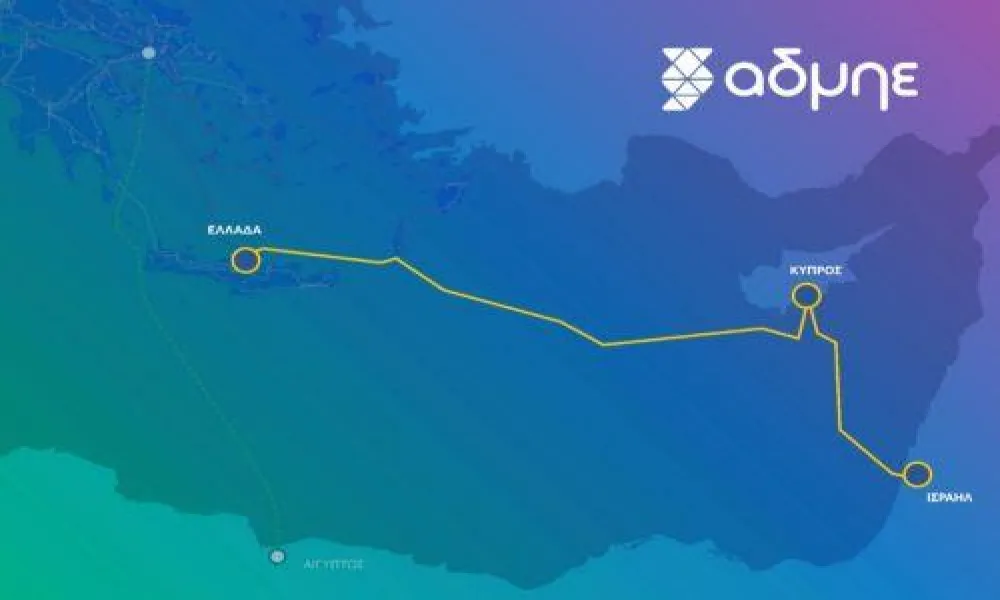

The Great Sea Interconnector (GSI) electricity link between Greece and Cyprus remains alive purely due to the political persistence of the European Commission and the Greek government. In practice, the major infrastructure project continues to hang by a thread, as Nicosia keeps all of its core objections firmly on the table. Despite deep-seated concerns regarding geopolitical risk, economic viability, and long-term sustainability, the Cypriot government has stopped short of pulling the plug.
From the November agreement to face-to-face talks
Progress had completely stalled since November 2025, when President Nikos Christodoulides and Greek Prime Minister Kyriakos Mitsotakis announced an update to the project's studies to attract investors. In late April, the energy ministries of both nations jointly announced a letter to the European Investment Bank (EIB) requesting an updated independent evaluation of the project's financial and technical data. Energy Minister Michalis Damianos emphasized at the time that final decisions would depend entirely on the findings of the EIB review.
Securing the EIB's approval is tied to a €1 billion financing package. Such backing would significantly de-risk the interconnector, opening the door for interested investors from the United States, France, and the Gulf nations. The EIB’s evaluation is expected to take roughly six months due to its standardized and time-consuming assessment procedures. While the public impression over Easter was that the project had found its footing, behind the scenes, Cyprus refused to lift its reservations, necessitating face-to-face meetings.
The informal Council of EU Energy Ministers in Nicosia provided that opportunity. EU Energy Commissioner Dan Jørgensen met with President Christodoulides, the ministers of finance and energy, and the deputy minister to the president on Tuesday. The following day, a broad meeting took place at the European Union representation in Nicosia, bringing together Jørgensen, the energy ministers of Greece and Cyprus, the vice-president of the EIB, and the CEO of Greece's Independent Power Transmission Operator (ADMIE).
Statement by Commissioner Jørgensen
The intensive two-day contacts culminated in a written statement by Commissioner Jørgensen, which pointed toward implementation while subtly revealing that major issues remain unresolved. Jørgensen reiterated that the European Commission has always supported the GSI as a vital strategic energy corridor designed to end Cyprus's energy isolation, stabilize the island's electricity grid, and lower electricity prices.
The Commissioner outlined that Brussels' commitment remains crystal clear:
- The EU has granted the GSI Project of Common Interest (PCI) status and allocated €658 million under the Connecting Europe Facility, representing one of the largest grants ever awarded by the mechanism.
- The Commission recently elevated the project's status by designating it as one of eight energy highways prioritized for the completion of the Energy Union.
Jørgensen noted that the Nicosia meetings with the ministers, ADMIE, and the EIB were explicitly aimed at providing fresh momentum for the project's execution.
Decoding the European position
Analysis of the Commissioner's intervention yields several key takeaways:
- The Commission views the project as a vital piece of the broader Energy Union puzzle. Cyprus's high levels of solar irradiation make it a potent exporter of green energy, but the island currently faces extensive renewable energy curtailments that can only be resolved via a connection to mainland Europe.
- Highlighting the €658 million grant serves as a reminder that the project has already met rigorous European sustainability and financial criteria.
- The political capital invested by European Commission President Ursula von der Leyen is significant, and Brussels expects a matching commitment from member states.
- The project retains a bi-communal dimension, as it would secure energy adequacy for the Turkish Cypriot community as well.
- Crucially, while Jørgensen spoke of giving the project "fresh momentum", his statement omitted whether that effort was actually successful.
The role of the Greek minister
Information obtained indicates that Wednesday’s meeting at the House of Europe could have easily resulted in a total collapse. The intervention of Greek Energy Minister Stavros Papastavrou proved catalyst, as he moved to defuse Cypriot anxieties regarding economic viability and geopolitical exposure. Athens appears ready once again to provide backing to overcome institutional hurdles, backed by the fact that the bilateral intergovernmental agreement has already been ratified into law by the Hellenic Parliament.
The underlying geopolitical risk remains Turkey. During Tuesday's meeting at the Presidential Palace, President Christodoulides raised Turkey's stance as a primary source of anxiety. In response, Athens has provided assurances that a repetition of the July 2024 Kasos incident—where the Italian survey vessel Ievoli Relume was obstructed by Turkish warships—will be prevented through a permanent Hellenic Navy presence alongside cable-laying vessels. This tactical doctrine was demonstrated last week when a Turkish missile boat attempted to disrupt optical fiber works between Astypalea and Kos, only to retreat after the Greek frigate Adrias intervened.
A temporary window of time
The EIB's multi-month evaluation process provides a political window for all sides. While the bank examines demand forecasts, cost scenarios, and return rates, the Cypriot government can avoid making binding moves.
The final EIB delivery will be definitive. A positive opinion coupled with substantial loan financing will make a Cypriot withdrawal politically difficult. Conversely, a lukewarm or negative assessment will hand Nicosia a powerful argument to demand a total redesign or renegotiation. Until then, the GSI remains in an intermediate zone where all parties publicly declare their support.
Fractures in bilateral relations
Nicosia's handling of the GSI is casting a shadow over its relations with both Athens and Brussels. In Brussels, officials find it difficult to decode what Cyprus actually wants given the immense political and financial capital already deployed by the EU.
From the Greek perspective, Cyprus's refusal to release the agreed €25 million annual payout to ADMIE is viewed as a practical lack of faith in the project. The Cypriot counterargument is that it must guarantee absolute economic viability and proven consumer cost reductions before passing project development costs onto taxpayers. Although the Cyprus Energy Regulatory Authority (CERA) approved a revenue structure allowing the recovery of up to €125 million across the 2025–2029 period, the government now maintains that disbursement is conditional on the project advancing "as a whole", asserting that the mere manufacturing of the cable is insufficient.
What is at stake for Cyprus
Beyond technical maneuvers, the choice for Cyprus is simple: remain dependent on expensive, polluting oil-fired domestic generation or connect to the European grid for cheaper energy and higher supply security. High electricity costs continue to undermine the competitiveness of the island's economy, household incomes, and business profitability.
Finance Minister Makis Keravnos has privately expressed concerns to interlocutors that the interconnector's usage fees will actually lock electricity prices at high levels. If the state officially shares this view—that the GSI will increase rather than decrease costs—it has an obligation to state so publicly and cancel the project. If it does not, the project must proceed swiftly and without further asterisks.