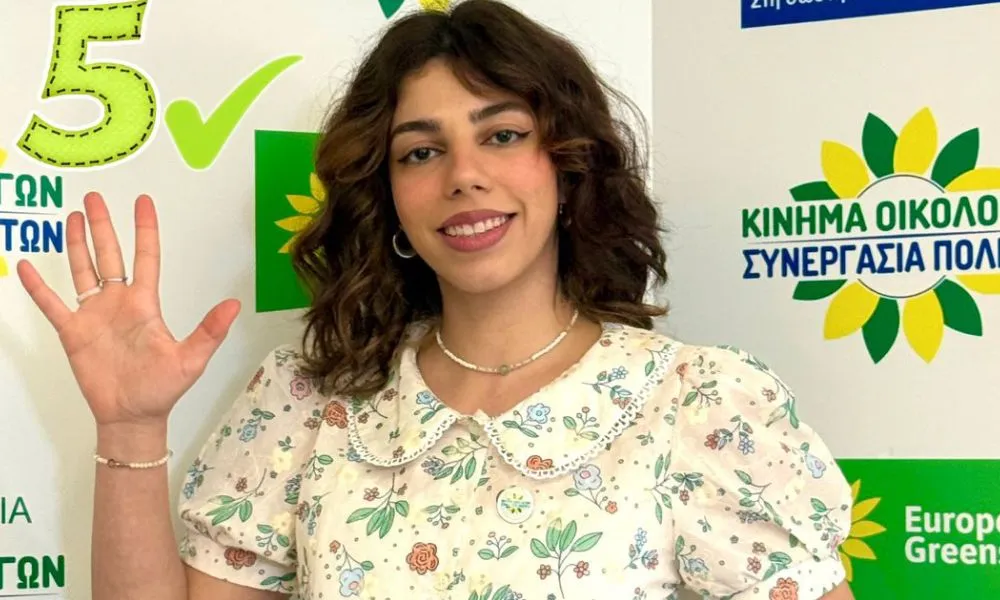

Sara Hussein belongs to Generation Z, she is 27 years old, and has spent 21 of those years in Cyprus. Of Kurdish origin, she was born in Afrin‑Rojava, in western Kurdistan, which, as she explains, is under Syrian control, and she now lives in Paphos.
In an interview with Politis, Hussein presents herself to voters and outlines the reasons behind her decision to run in the upcoming parliamentary elections in the district of Paphos with the Ecologists Movement – Cooperation of Citizens.
“Cyprus embraced us”
“I want to give something back to the country that gave me the opportunity to stay here, to live, to be educated and to have prospects. Sometimes I think: if I hadn’t been in Cyprus, where would I be? What would I have become? Would my life resemble what I live here today? Or would it have stopped at some point because of war? I am truly grateful that my parents managed to come to this country and, as difficult as things were financially in the beginning, I see that Cyprus embraced us. It gave us the opportunity to live, to love it and to feel safe… To go to sleep and wake up knowing you have a safe roof over your head is a big thing.”
Her family left Kurdistan for political and family reasons. “We had no rights at all; we could not even speak our language. My parents decided to move to a country that could offer us the rights we were entitled to. So that we would not be afraid to speak our language, to live as human beings and to exist.”
Two identities coexisting
As she says, she feels both Kurdish and Cypriot. The two identities coexist equally within her.
“I cannot detach myself from my roots. It is something within me. I feel it. I speak Kurdish and both my parents are Kurdish. At the same time, I came to Cyprus at the age of six, attended school in Polis Chrysochous and studied in Paphos. My education, ultimately, is Cypriot. I studied architecture and work as an architect in Paphos. I have much in common with Cypriots and I care about our country.”
She admits that the early years were not easy. Her family had to secure permanent residency, find work and stand on their own feet. At the time, they had Sara and another younger child, while a third sibling was later born in Cyprus. Over time, she says, things improved.
“In the beginning, I felt different. I was among people speaking a language I didn’t understand. Once I learned the language and connected with people, I integrated into society. I made friends and feel deeply connected to Cypriot society.”
Citizenship in 2020
She obtained Cypriot citizenship in 2020. Her parents are still waiting.
As she explains, the values and experiences from both cultures have shaped her outlook on life, based on respect, resilience and coexistence. Her involvement in public life stems from a strong sense of justice. Inequality and injustice, she says, should not be accepted, while dignity and rights are non‑negotiable. At a time of pronounced individualism, she emphasises solidarity and collective progress.
Entering politics
If elected, she says she wants to focus on social issues such as the cost of living, housing and corruption.
“People are going through very difficult times. Families are struggling. Whether you buy or rent a home, it is extremely difficult, especially for young people, who now feel that owning a home is something that exists only in dreams. And the situation keeps getting worse. The average citizen does not live – they simply survive.”
She stresses that the country needs voices against corruption and stronger tools for transparency.
“It feels as though the government belongs to the few. That must change. Citizens need to know exactly what is happening, because ultimately the government works for the people, not the other way round.”
Her election, she notes, does not depend on the Kurdish community with Cypriot citizenship, which is relatively small in Paphos. Her friends will support her and are proud of her candidacy.
“This does not mean there were no negative comments such as ‘what is a foreigner doing in parliament?’ But despite that, my family here and in Kurdistan were very happy with this step. It is in our nature as Kurds to fight – we don’t give up easily. And since I live in this country, I want to fight for Cyprus and I feel I owe it something. I live here, I want to give something back. I want to do that through politics.”