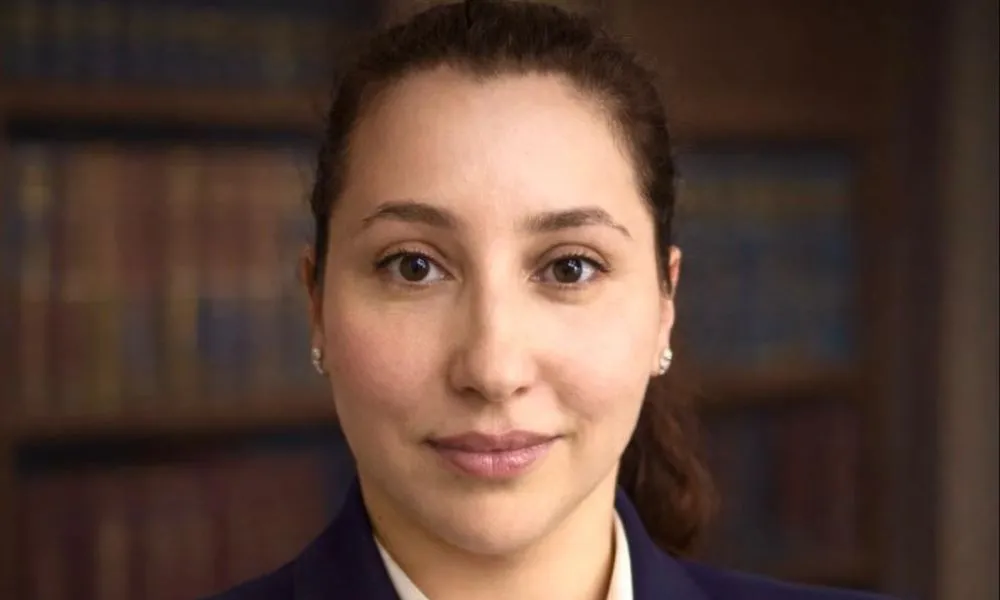

Borka Grozdanovska comes from Skopje. She is a nurse with 19 years of professional experience in Cyprus, more than ten of which have been spent in intensive care units. She studied at one of the top public higher education institutions in North Macedonia, Goce Delčev University, and is also a graduate of the secondary medical school in Skopje.
21 years in Cyprus
She settled permanently in Cyprus, specifically in Limassol, in 2005, when she came to the island as what she describes as a “love migrant”. She married the same year and the following year gave birth to her son. She adapted easily to Cypriot society. As she explains, she had no difficulty learning Greek, which she now speaks fluently. In addition to her native Macedonian, she also speaks English as well as Serbian and Bulgarian at a high level.
Learning Greek was, for her, a necessary condition, first for communication with her new family in Cyprus, who embraced her and made her feel part of it from the very beginning, then for her integration into society and for communicating with patients in the health centres where she began working at the end of 2006.
With ALMA in Limassol
The proposal for her candidacy with ALMA came from a doctor colleague who is a party member. He recognised her dedication and her people‑centred approach in everything she had pursued over the years.
“We worked together in intensive care and he knew my path in Cyprus as well as my interest in public affairs. At first I did not want to, because you understand the level politics has reached. So I thought it was not a very good idea. Then I reconsidered and revised my position. I am an active citizen. Through my work I am in contact with our fellow citizens. I have joined the Cyprus Intensive Care Forum, and as a mother I have always been an active member of parents’ associations. I fight for the protection of human rights and I believe I can do this through Parliament if elected.”
She believes that children’s rights must return to the centre of decision‑making and proposes extending maternity leave to one year, as well as strengthening infrastructure related to childcare and protection, especially for preschool‑age children.
A team player
She considers her ability to work as part of a team as her main strength.
“No one can change the world alone. What I see a lot during the election campaign, and it bothers me, is that most candidates try to promote themselves as if they will make all the changes on their own.”
For this reason, she believes in teamwork and in seeking common ground.
“If elected, I would like to focus on health, the protection of patients’ rights and more.”
Some people ask her about her positions on the Cyprus problem and what she would do.
“It is often a question that carries doubt. The fact that I was not born here does not mean I do not care. What I ask each time is what the other MPs who were born in Cyprus have done over the past 50 years.”
Nursing law
Regarding the reform of the nursing profession, which was left unresolved by the previous Parliament, she has clear positions. She believes that the language requirement, which has been at the centre of disagreement between nurses and private hospitals, cannot be compromised.
The requirement for a very good knowledge of Greek is, in her view, a non‑negotiable condition for practising the profession and for registration in the Nurses’ Registry.
“I believe from my experience that no one can work in a hospital without knowing the language of the country they are in. It is a matter of communication with doctors and patients and therefore a matter of health safety.”
She also believes that the shortage of nurses could be addressed by utilising nursing students from third countries who study at private universities. Although their teaching is in English, they are required to learn Greek from the first day of their studies.
“This means,” she explains, “that by the time they complete their four‑year studies and reach the stage of clinical practice, they have a very good command of the Greek language. All of them could work in Cyprus if the current legislation, which does not allow it, is amended.”
In this way, she argues, the shortage of nurses could be addressed and the sector’s needs covered.