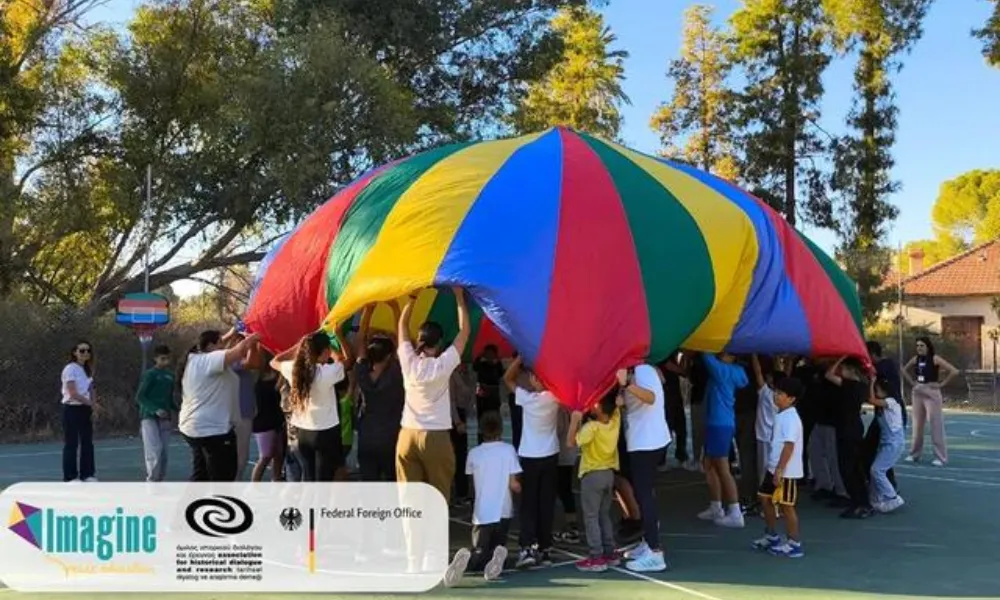

A plan for the resumption of the Imagine bicommunal education programme is expected to be ready within the coming weeks, according to Michalinos Zembylas, the Greek Cypriot co-chair of the Technical Committee on Education.
Speaking to Politis Radio, Zembylas said discussions with the Turkish Cypriot side are already under way on how the programme, suspended in October 2022, can be relaunched.
He welcomed the recent decision by the two leaders to support the programme's return, saying it gives the committee renewed momentum to continue its work.
New education ministry circular expected
Zembylas said a new circular from the Education Ministry is expected within days.
According to him, the committee received assurances on the matter from Education Minister Athina Michaelidou during a meeting held over the summer, and the ministry was likely waiting for the leaders' formal decision before proceeding.
Why the programme was suspended
Referring to the 2022 suspension, Zembylas said then Turkish Cypriot leader Ersin Tatar had justified the move with claims that the programme was encouraging children to adopt a culture of peace.
He said certain newspapers in the north criticised Imagine because it promoted coexistence rather than the vision of two separate states.
Zembylas described Tatar's tenure as one of the most challenging periods for the Technical Committee on Education because of communication difficulties and a lack of cooperation.
He added that opposition to the programme emerged in both communities and was often based on similar arguments advanced by what he described as more extreme circles.
Bringing students together
The Imagine programme aims to bring together Greek Cypriot, Turkish Cypriot and other students through activities that promote peace, empathy and respect for human rights.
The process begins with visits by trained facilitators to schools in each community, followed by joint activities at the Home for Cooperation in Nicosia.
Students can then continue communicating online, while many maintain friendships after taking part.
Zembylas stressed that the programme does not address the political dimensions of the Cyprus problem and is designed as an educational initiative.
However, he acknowledged that education inevitably carries a broader social and political dimension because it promotes specific values and attitudes.
Positive feedback and German funding
According to Zembylas, assessments conducted through the Association for Historical Dialogue and Research have produced consistently positive feedback from participants through questionnaires and interviews.
He highlighted the importance of integrating the programme into the regular school day, with activities taking place during morning hours.
The programme has been funded entirely for the past decade by the German Foreign Ministry, while neither the Republic of Cyprus nor the Turkish Cypriot side has contributed financially.
New projects under discussion
Zembylas also revealed plans for additional bicommunal initiatives, including an environmental education programme being developed with the Technical Committee on the Environment.
Other proposals include joint educational activities in mathematics, physics and technology.
He said young people increasingly share concerns about issues such as artificial intelligence and that their hopes, fears and aspirations often extend beyond questions of national identity.