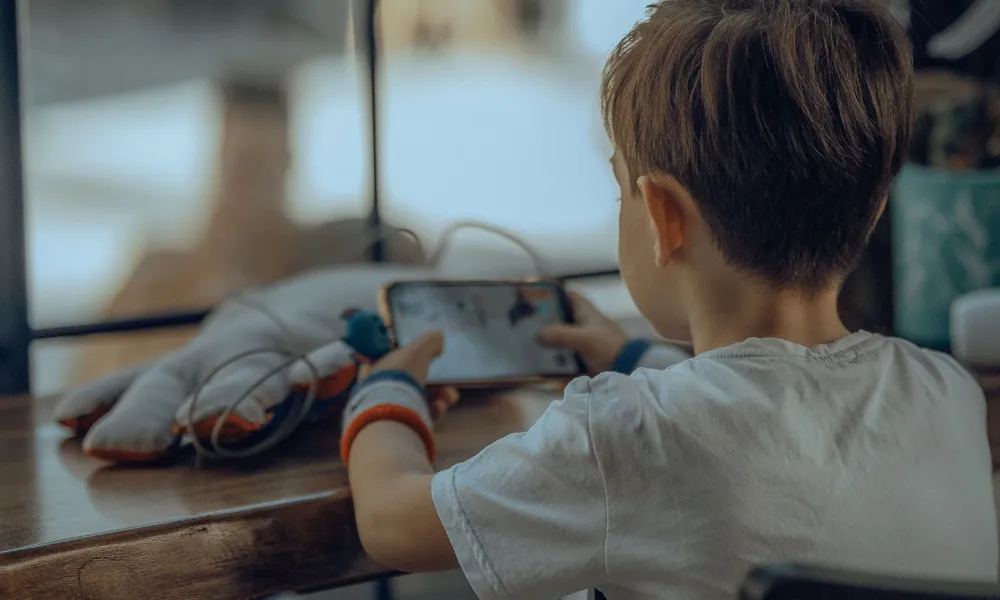

How many times a day does a parent hand their mobile phone to their child "for five minutes" or "to calm them down"? How many times do they eat with their eyes on the screen, or answer a message while the child is trying to talk to them? And how easy is it, in the end, to raise a child away from screens, in an era when the lives of adults themselves revolve around them?
At the beginning of last week, the European Commission published the recommendations of its expert group on the protection of children in the digital world. Among other things, it proposes avoiding exposure to screens until the age of three, the use of digital devices only in the presence of an adult until the age of 12, and no access to social media before the age of 13.
However, the new European recommendations are not limited to age limits or prohibitions. They open a much larger discussion about the way families use technology in their daily lives. The real challenge is not only when a child will acquire a mobile phone or a social media account, but how it will learn to live in a world where screens are everywhere.
Tips for parents and teenagers
The European expert group insists that a healthy relationship between children and technology is not formed at the moment they acquire their first mobile phone or open their first social media account. It is built much earlier, through small daily habits that can limit excessive dependence on screens and strengthen their safe use.
The experts recommend that children up to the age of three avoid, as far as possible, exposure to screens, while up to the age of 12 devices should be used only in the presence of an adult. At the same time, they call on parents to check whether apps and games are appropriate for the child's age, to avoid devices in the bathroom, the bedroom or during meals, and to establish daily screen-free periods for all members of the family.
Particular importance is attached to the relationship of trust between parent and child. Parents are encouraged to prompt children to speak up when something worries them and to discuss with them what they see online. The conversation about online safety, it is stressed, does not stop when the child grows older, but must continue into adolescence.
The recommendations are addressed to minors themselves as well. Children and teenagers are called on to think before they post, to protect their personal data, to avoid requests from strangers, to use safety settings and not to trust uncritically what they see online. Particular reference is made to artificial intelligence, since images, videos, voices and messages may be manipulated or entirely fake.
If someone bullies them, threatens them or makes them feel uncomfortable, the recommendation is clear: block, report, keep the evidence and inform an adult they trust.
The example set by adults is considered equally important. Parents are called on to avoid so-called "sharenting", that is, publishing photographs and videos of their children without considering how this material might be used in the future, and to limit their own mobile phone use when they are with them. Responsible use of technology, after all, cannot be a rule only for children.
Common rules
Many children begin asking for a mobile phone or tablet from as early as the age of one or two. According to school psychologist Maria Solomou, this is no accident. The child observes daily the parent's relationship with the device, imitates it and, in some cases, even comes to feel jealous of the time the parent devotes to the screen instead of to the child. "We cannot ask children to limit their use of screens when we ourselves are constantly in front of one. Children learn primarily from the example we set them and less from what we tell them," the school psychologist explains to Politis.
Asked to comment on the EU recommendations, she said they move in the right direction, making clear at the same time that rules can only work when they are applied consistently and do not concern children exclusively.
She underlines that removing a device without explanation and without alternative activities is more likely to provoke conflict than to cultivate self-regulation. The child needs space for play, movement, communication and the meaningful presence of parents, but also to learn gradually to recognise when the use of technology begins to affect its sleep, concentration and relationships. As she points out, the goal is not to raise a child that obeys because its phone was hidden away, but a child that understands why it needs to set limits on its own.
Not just a ban
The Commissioner for the Protection of Children's Rights, Elena Pericleous, also came out in favour of excluding screens until the age of three. Speaking on Politis radio, she described the recommendation as correct, while acknowledging that implementing it is not always easy for families.
She placed particular weight on the issue of social media and the possible imposition of an age limit, noting that "a ban, regardless of the age limit chosen, will not deliver results without parallel digital education".
She used driving as an example, adding that "just as reaching the legal age does not mean someone can automatically drive safely without training and a licence, so delayed access to social media does not by itself protect a child that has not previously learned to navigate the digital world".
The view from inside the classroom
While no age restriction on social media has so far been imposed in Cyprus, as is already the case in other countries, another restriction has been in force here for about two years: the ban on the use of mobile phones inside school premises. And who better to judge the measure than a pupil who experienced both the period before and the period after the ban?
Stefani Nikolaou, who graduated from lyceum a few weeks ago, confirms in statements to Politis that restrictions can change certain behaviours, but on their own they are not enough. "The ban helped a lot during breaks. We saw more children talking to each other, laughing, playing, instead of being constantly hunched over a screen. At the beginning, of course, there was quite a lot of resistance. Some pupils continued to bring their phones to school secretly, there were incidents and tensions, because many found it hard to adjust. Myself among them," she said, adding: "It's not easy when for years you've been used to scrolling even during lessons, and suddenly your phone is taken away."
However, as she points out, the bigger problems did not disappear. "Bullying and cyberbullying didn't stop. They simply moved to after school, when everyone returned to their phones and social media. Videos no longer circulated when fights broke out between pupils, but we still had incidents of violence, even against teachers," she added. She stressed that "school is only one part of the day. When lessons end, we all return to the same digital world."
What does the parent say, and what does the parent do?
We also asked her to comment on the restrictions proposed by the European Union. Her answer was, admittedly, disarming. "But how do you tell a child of 10 or 11, who grew up with a mobile in one hand and a tablet in the other, to limit its screens, when its mum, its dad and everyone else around it are themselves dependent on them?" she wondered, putting yet another issue on the table at the same time. "The line we always hear is 'put the phone down for a bit', usually followed by 'at your age I went outside, I played with my friends, I wasn't constantly in front of a screen'. These phrases are neither an argument that helps children unglue themselves, nor do they work constructively in the effort to bridge the generation gap that exists between a parent and their child."
For Stefani, change cannot concern only the children. "Adults often ask us to put down the phone, but they themselves constantly have one in their hand. It's difficult to convince a child to limit its use when it sees its parents doing exactly the opposite. I think we all need to change together. The rules must apply to everyone."