
The completion of the second Cypriot presidency of the Council of the European Union found the government presenting a catalogue of legislative and political achievements, maintaining that it lived up to the high expectations of a particularly demanding period for Europe. However, the substantive assessment of a presidency is not made only on the basis of the number of files closed but, above all, on whether it managed to influence the strategic direction of the Union, to function as an honest broker and to leave a political legacy. In this context, the Cypriot presidency can be characterised more as a successful managerial presidency than as one that changed the balances in the European Union. Nevertheless, competence in managing the complex daily routine of European politics is no achievement of lesser importance. There is also one matter of strategy in which the Cypriot presidency achieved a result with long-term impact: the advancement of Ukraine's accession course. The Republic of Cyprus proved in practice a substantive ally of Kyiv.
Enlargement
Cyprus took the helm of the EU Council at a particularly complex juncture. The war in Ukraine continued to define much of the European agenda, pressures for strengthening European defence and competitiveness had intensified, while negotiations for the new Multiannual Financial Framework had already begun to generate confrontations between net contributors and beneficiary states. At the same time, the debate on Europe's Strategic Autonomy had to move from theory to practice.
From a European perspective, the strongest imprint of the Cypriot presidency concerns, as already noted, the enlargement process. Several analysts acknowledge that Nicosia exploited the juncture to accelerate the accession processes for Ukraine and Moldova, while progress was also recorded in negotiations with Montenegro and Albania. Enlargement effectively returned to the centre of European strategy as a tool of geopolitical stability against Russian influence in the Balkans and Eastern Europe.
Equally significant was the effort to promote European competitiveness. The Cypriot presidency actively supported the simplification of European legislation through the so-called omnibus proposals, aiming to reduce bureaucracy for businesses, particularly small and medium-sized enterprises and start-ups. These are timely issues at a moment when Europe is seeking ways to close the technological gap with the United States and China.
The budget
Managing the debate on the new seven-year European budget, with the aim of advancing the consultation and putting numbers on the table, was one of the most difficult missions of the six months. The Cypriot presidency delivered a negotiating framework with figures. The proposal did not please the net contributors who want cuts, but the goal was for a proposal to exist.
The proposal tabled attempted to balance between the pressures of countries demanding spending restraint and those seeking to preserve cohesion funds and the Common Agricultural Policy. Although it was clear that no proposal could constitute a final agreement, the Cypriot presidency was able to shape the framework upon which negotiations will continue under the Irish presidency.
Where expectations exceeded results, however, was in elevating the Eastern Mediterranean as a strategic priority of the European Union. Cyprus's geographical position, developments in the Middle East, energy security and migratory pressures created the sense that the presidency could shift European interest further towards the region. Although significant meetings took place, with the informal Summit in April attended by leaders of the region as the highlight, no decisions were recorded that constitute a substantive change in European strategy.
The numbers
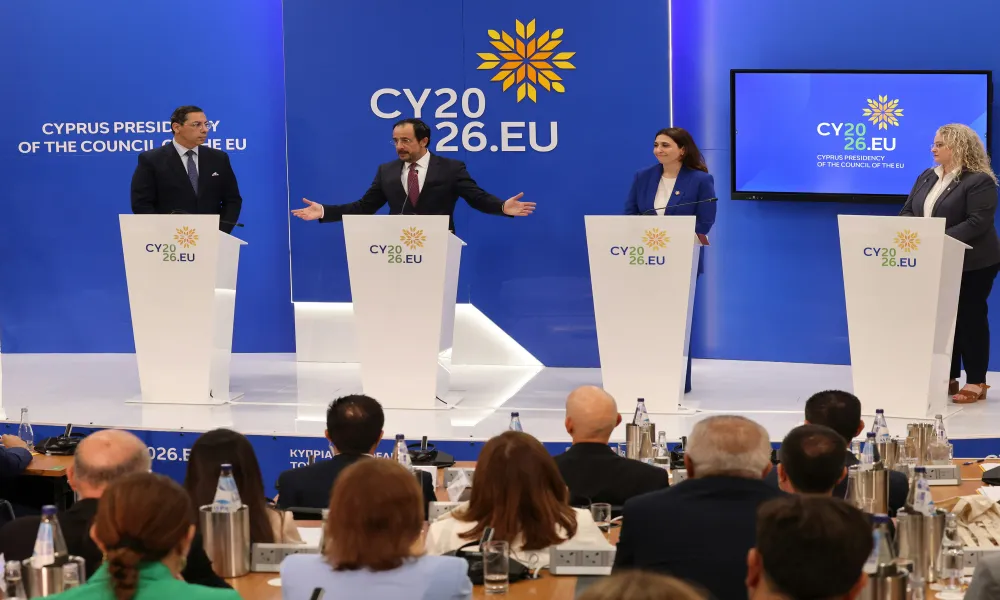
According to the review of the Cypriot presidency, presented by President of the Republic Nikos Christodoulides, Foreign Minister Constantinos Kombos and Deputy Minister for European Affairs Marilena Raouna, during the six months Cyprus had responsibility for managing more than 345 legislative files, examined through more than 1,500 meetings in 195 Council working groups.
According to the presidency's official figures, 27 of the 32 political trilogues with the European Parliament and the European Commission were completed, a success rate above 84%, while 41 general approaches and 22 Council Conclusions were approved. Ten packages simplifying European legislation were completed and negotiating mandates were secured for four more initiatives.
More than 230 European events were held in Cyprus, attended by almost 25,000 representatives of governments, institutions and organisations from across Europe. The programme included the first informal Summit of European leaders hosted in the country, 19 informal ministerial councils, the visit of the College of Commissioners and of the Conference of Presidents of the European Parliament, as well as the Conference on Islands and Coastal Areas, which sought to highlight insularity as a horizontal European policy. Finally, more than 500 artists took part in cultural activities staged in 31 countries, boosting Cyprus's international profile.