One of my Greek Cypriot readers has informed me about a possible burial site in the area of Lapithos and I wrote to the Cyprus Missing Persons’ Committee about it so that they can investigate further…
My reader, in essence wrote the following:
“Dear Sevgul, long time we didn't talk but I see you on FB. I want to tell you some information I learned today. In Lapithos there is a place called "Okto Lithari" or "Ofto Lithari". There, they believe that around 50 Greek Cypriots were executed in 1974. They were transferred there (They were not there, they were taken from elsewhere to Ofto Lithari to be killed and buried.)
The person who told me about it, supposes that the Authorities know about it, but it's better to mention it, just in case they didn't. According to him, they were buried there. The initial information was from a person called …. from Lapithos (his name is kept confidential by us – S.U.). He died some years ago. I wonder whether he gave his knowledge to anybody… It is the first time I heard about this locality ''Oktolithari".
The locality Oktolithari is near locality Agnin and they are not far from the School of Lambousa, about half a kilometer away… Oktolithari is almost half a kilometre west of Vrysi tou Parpa, and towards the sea…. The possible burial site is at Oktolithari and Oktolithari is half a kilometre from Vrysi tou Parpa.
As for the Lapithos School of Reform, this school was a school for children who had bad behaviour (with the standards of that time). Now there is no such school. Many people know where it was because there was a traffic sign. It was between the main road to Kyrenia, and the sea. The School of Lambousa was known as 'Sofronistirio'. Oktolithari means 8th Stone. But no relation with miles.”
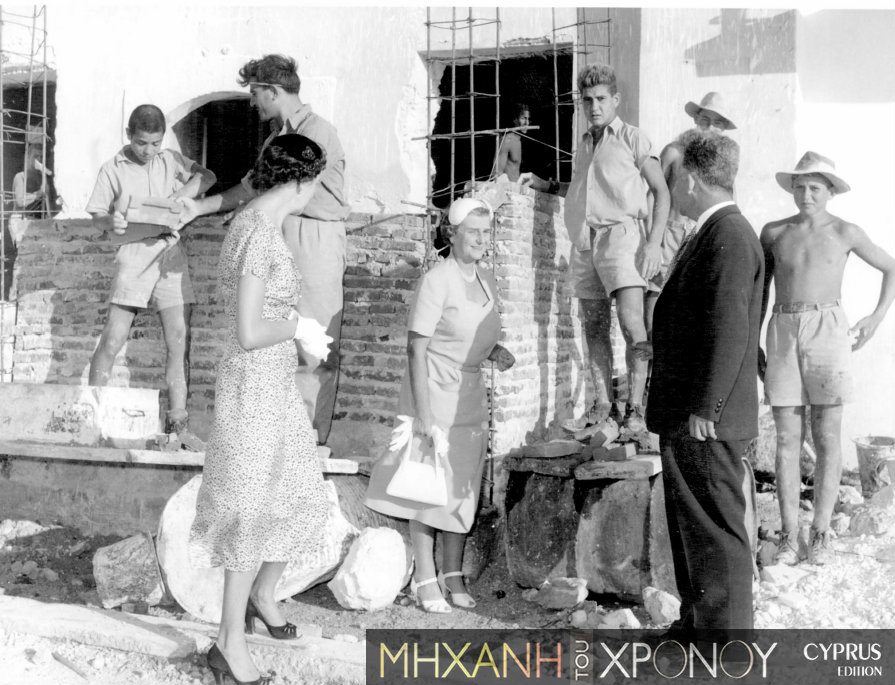
Kids working at the construction of Lapithos Reform School.._
I thank my reader for this valuable information. If you have any information about this possible burial site, you can contact me with or without your name on my CYTA mobile at 99 966518 or you can contact the Cyprus Missing Persons’ Committee directly.
The multicultural reform school
For me it was quite interesting to find out that the school my reader was mentioning, the reform school of Lapithos for kids who had committed some crimes at a minor age was in fact a multicultural reform school. Turkish Cypriot, Greek Cypriot, Armenian and Maronite children attended this school together, got education as well as some skills that would help them in their later life…
According to the “ΜΗΧΑΝΗ ΤΟΥ ΧΡΟΝΟΥ” (“TIME MACHINE”) website, the history of this school was as follows:
In the early 1940s, Dr. Sleight, director of the Teachers' College in Cyprus and later director of education for the colonial government, was considering ways to modernize the Cypriot education system. A pioneer with a genuine interest in education, he established various schools that were missing from the island's educational map, such as technical, hotel, and other schools. One of these was the Lapithos Reformatory School. An innovative idea that ended up becoming a model for European standards....
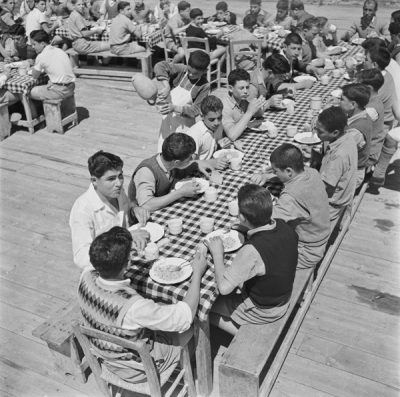
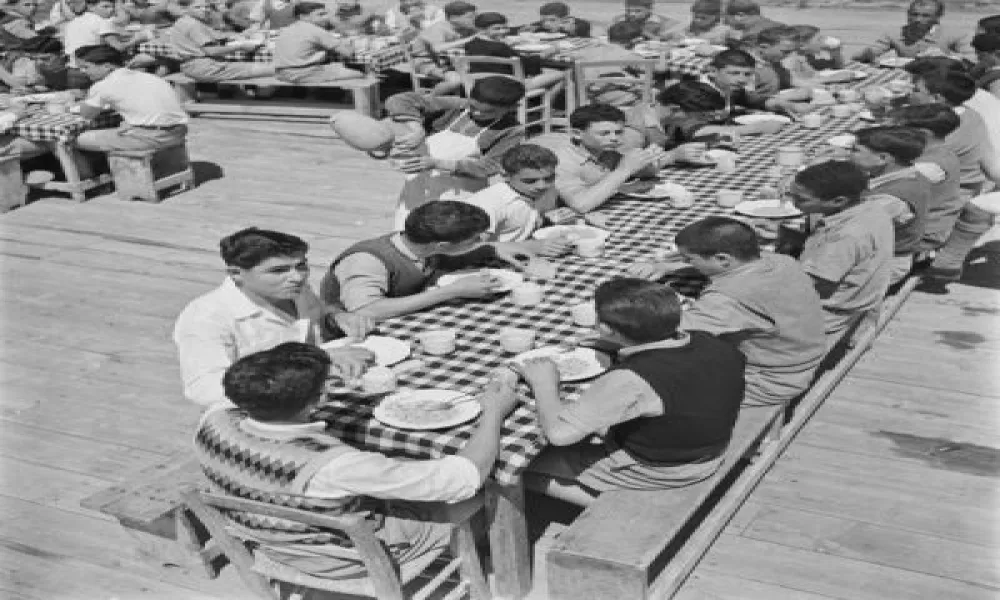
Kids having lunch at Lapithos Reform School
“…Early 40's, Dr. Sleight, Director of the Teaching College in Cyprus and later Director of Education of the Colonial Government, was thinking of ways to modernize the Cypriot education system. A pioneer and with a real interest in education, he founded various schools which were missing from the educational map of the island such as Technical School, Hotel School and others. One of them, however, was the Reform School of Lapithos.
The main problem, however, was finding a location. As Michalis Kokkinidis, teacher and later director of the School, recounts, Dr. Sleight was well aware of the province of Kyrenia. On one of his tours, he found the old hotel of Taliadoros. This was built on the foundations of a carob warehouse. However, the hardships and the economic crisis of the war never allowed him to function. On the other hand, this was fortunate for Sleight. He had just found the location for the new school.
Sleight's proposal, however, although he managed to convince the education directorate and the colonial government, he met the denial of the Athalassa prisons to which the children were sent until then. The counter-argument was: “If we move the young prisoners, who will now take care of the animals in the mansion of Athalassa?”
In the Fall of 1943, the School began to accept the first students. However, it was not fully equipped and neither had the necessary facilities. This, of course, did not deter anyone. Teachers and technical staff were hired and the children were divided into three groups: the Kids, the Greens and the Venetos, according to their age. At first they lived in shacks with their responsible teachers, but slowly the students along with the builders and carpenters who had been hired in the School began to build the new school.
In any case, the philosophy of the School was that children would be given the basic knowledge and the opportunity to learn a craft that could ensure them a living when they were fired from the School.
The children created a small town. They built the dormitories that housed them, a large sports hall, workshops, classes, kitchen and dining room and a main building and a farm called Mansion.
The new school… was a model for the region… The staff consisted of the teachers, craftsmen, cooks and housekeepers of the School. Indeed, as it hosted Greek Cypriot, Turkish Cypriot, Maronite and Armenian children, the staff was mixed. There was no discrimination and respect was one of the main principles of the school. The Reform School of Lapithos had created a large family.
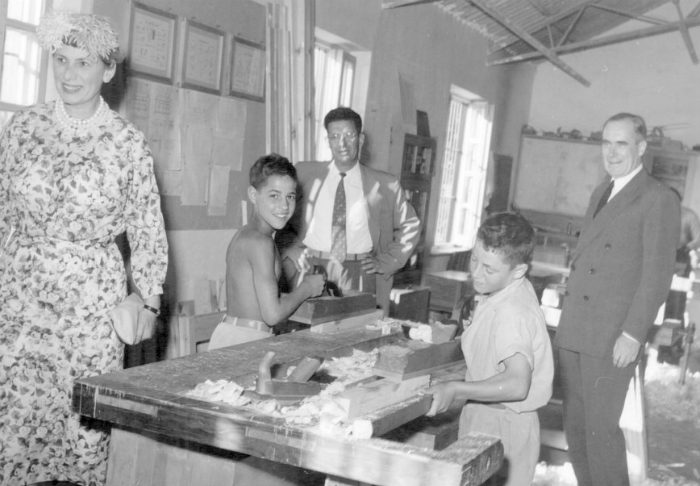
Kids at the workshop of Lapithos Reform School
What made the School stand out was its special philosophy. As narrated by Mr. Kokkinidis, they did not intend to punish children for being considered lawbreakers. On the contrary, their main concern was to give them a second chance and help them integrate smoothly into society after their release.”
"Good Conduct allowance"
According to the “ΜΗΧΑΝΗ ΤΟΥ ΧΡΟΝΟΥ” website, the school had no fencing, no railings, no doors. In the words of the Headmaster Mr. Kokkinidis at this website:
“The school had no fencing. No railings, no doors. So when new kids came, we were very scared and prepared for escapes. Something that was happening, not often, but was happening. One day, a kid left as soon as he was brought to the school. The communities of Karavas and Lapithos were informed, and whenever someone left us, was returned. So I got my car and found him… When they realized what a good time we were having and that we were not meant to punish anyone but to give them care, protection and knowledge, the little ones did not only stay in the School but on vacation begged to stay as volunteers inside. The school never closed. It stayed open all year, hosted parents who visited their children and when giving permission to the students at Christmas, Easter and Summer, some volunteered back to take care of the garden and the animals they maintained.”
According to “The Time Machine” website, “The School did not function like the well-known penitentiaries. Corporal punishment, says Mr. Kokkinidis, it was too rare and even only was done on behalf of the Director. No teacher had the right to lay a hand on the children…”
“We had other kinds of punishments. For example, every day teachers gave marks on the children's behaviour and their progress in lessons and the crafts. For these grades each month they received a good conduct allowance, something like a pocket money (apart from the monthly allowance they received that was saved until their release). When a student did not complete the necessary grades, then he also lost the allowance. That's why all the kids were trying to abide by the rules. It was important for them.”
“The school did not lack in any social aspect. The students had created spectacular sports and scouting teams and always took part in all the events of the province of Kyrenia.”
The war in 1974
But war came in 1974 and this put an end to the long-standing operation of Lapithos School of Reform (or Lambousa School).
According to the “Time Machine” website, Mr. Kokkinidis recalls: “We saw the Turkish invasion. We saw the planes and ships from the hill we were at. We were nervous. I sent my family to Karavas to our relatives and made sure to take the children with the teachers to a safer location…. As soon as we made sure we had room for safety, we sent the children to their homes. Those of us who did not have anywhere to go, we ended up in Prodromos and from there in Limassol. I never went to school since. I can't.”
“The School remained closed from ’74 to 80’s. Then a recommendation was made to reopen. A site in Polemidia was designated as a new space, where the Hotel School was later housed. The new Lambousa School worked with the same philosophy, just as nothing reminded of what was created in Lapithos. Things were more difficult. There was not the same bond. In fact, the officials of the new government were not as interested as they were before the invasion. They did not visit us even once. The government officials closed us down in 1986…”