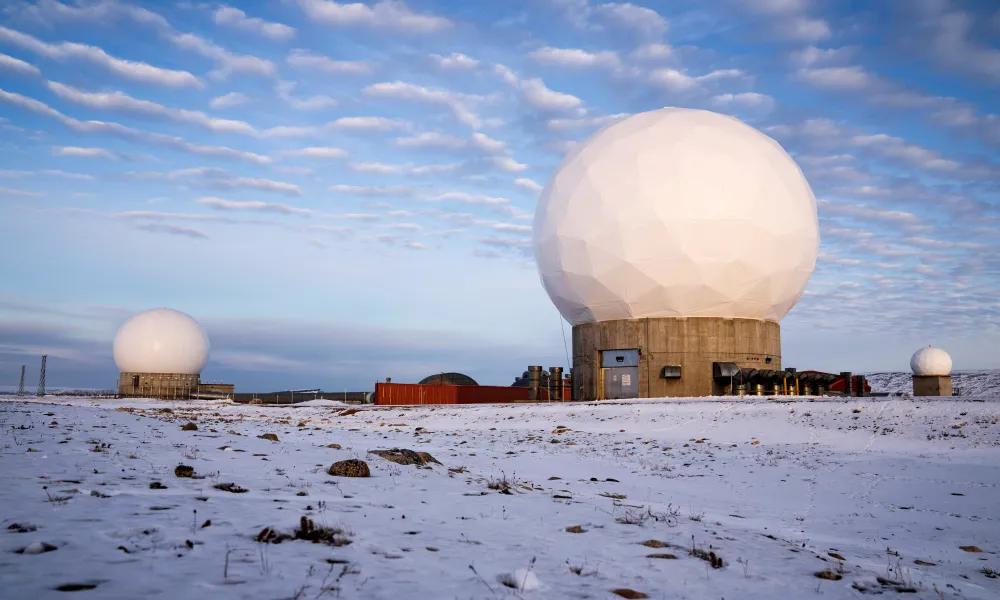
The United States is seeking a full revision of its defence agreement with Denmark, aiming to remove all restrictions on its military presence in Greenland. According to Bloomberg, Washington wants to rewrite key provisions of the agreement, effectively turning the island into a zone of unrestricted military activity, in negotiations that have become central to meeting the demands of US President Donald Trump.
The provisions under review
The original 1951 defence agreement, as amended in 2004, stipulates that the United States must “consult and inform” Denmark and Greenland before making any “significant changes” to its military operations or facilities on the island. This clause is reportedly the main target of US negotiators, who seek its removal or dilution in order to eliminate any legal or political constraints.
Sources familiar with the talks told Bloomberg that the US side is pushing for language that would guarantee complete freedom of movement, without time limits or operational restrictions. The final terms of the agreement remain under negotiation.
White House position
White House spokesperson Anna Kelly said that “if this agreement is finalised – and President Trump is particularly optimistic – the United States will achieve all of its strategic objectives in Greenland, at minimal cost and on a permanent basis”. She added that further details will be announced once all parties reach a final agreement. The Danish embassy in Washington declined to comment.
Trump’s public statements and NATO dimension
The reported position aligns with statements made publicly by Trump. On Wednesday, he said there was a “framework for a future agreement” on Greenland following his meeting with NATO Secretary General Mark Rutte at the World Economic Forum in Davos, without providing further details.
“We will all work together. NATO will also be involved,” Trump said, suggesting that the agreement would extend beyond bilateral US–Denmark relations to include the alliance. Upon returning from Davos, he indicated that within two weeks he would clarify whether Copenhagen had given its consent.
In an interview with Fox Business, Trump was more explicit, stating: “We will have all the military access we want. We will be able to place whatever we need in Greenland. It is essentially full access, without an end date and without a time limit.”
Broader geopolitical implications
A final agreement could help ease what many describe as the most serious crisis in transatlantic relations since the founding of NATO after World War II. According to earlier Bloomberg reports, the framework outlined by Trump includes the deployment of US missile systems, mining rights aimed at excluding Chinese interests, and an enhanced NATO presence in the Arctic. In return, the US President would commit to not imposing tariffs on European countries.
Shift from post-Cold War policy
The strategy marks a departure from recent decades, during which the United States significantly reduced its presence in Greenland after the end of the Cold War. From as many as 17 bases, the US currently maintains one main facility, hosting around 150 military personnel and more than 300 contractors, many of whom are Danish or Greenlandic nationals.
Denmark and Greenland cautious
It remains unclear to what extent Denmark and Greenland are willing to accept changes of this scale. Danish Prime Minister Mette Frederiksen said both sides are open to a “further expansion” of the 1951 defence agreement, but stressed that this must be done “in the right and respectful way”.
Former US officials note that the existing framework already provides Washington with considerable operational flexibility, and that both Denmark and Greenland have for years encouraged a stronger US military presence, which also supports the local economy. As Iris Ferguson, a former US Deputy Assistant Secretary of Defense, observed, “there was always a willingness to discuss” additional involvement whenever the US requested it – a reality that helps explain why Greenland is now at the centre of a geopolitical negotiation with global implications.
Source: Newmoney.gr