
President of the Republic Nikos Christodoulides held a series of meetings in Brussels on 18 March, combining public interventions with bilateral contacts at EU and UN level. The discussions centred on security, the Cyprus issue, the foot-and-mouth disease outbreak and broader regional developments. His engagements continue today with participation in the European Council.
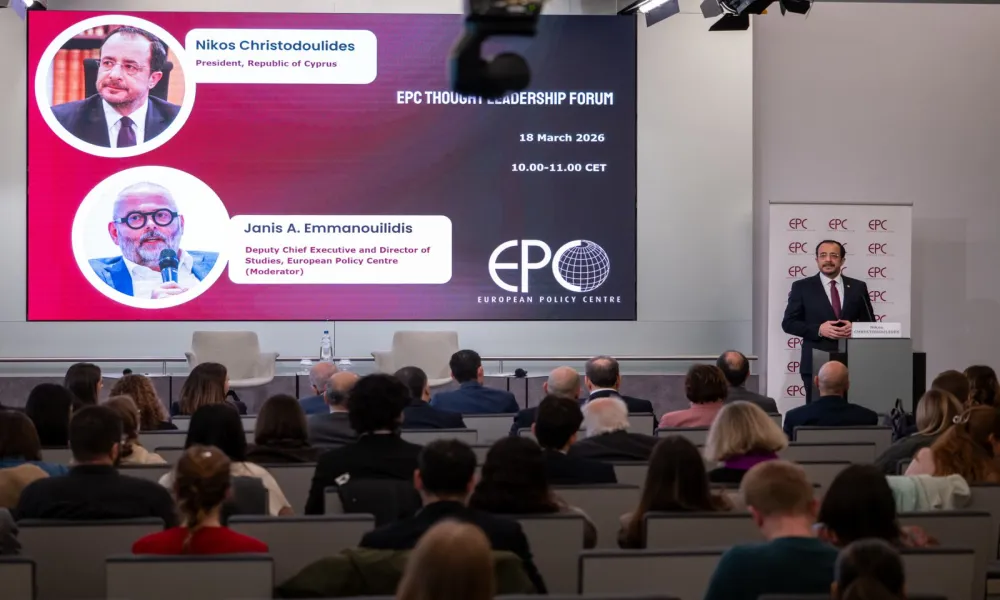
Intervention at the European Policy Centre
The day began with an address at the European Policy Centre, where the president highlighted what he described as practical European solidarity following the recent drone incident near British bases in Cyprus.
He noted that support from countries including Greece, France, Italy, Spain and the Netherlands gave substance to the EU’s mutual assistance clause, despite it not being formally activated.
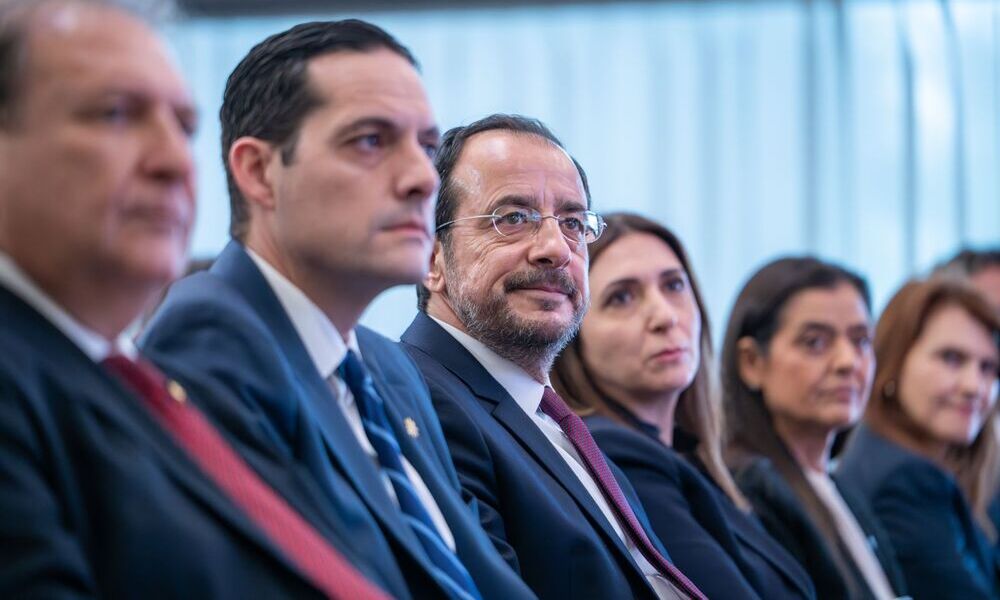
He argued that the European Union must not only maintain such mechanisms but ensure their operational effectiveness during crises. In this context, he linked Cyprus’ experience to the broader discussion on EU strategic autonomy and the need for faster and more coordinated responses.
Positions on the Cyprus issue and regional developments
During the discussion that followed, the president reiterated that there is no alternative solution to the Cyprus issue. He stated that the European Union has the tools to demonstrate to Turkey the benefits of a settlement, adding that Ankara would move towards a solution only if it considers those benefits to outweigh the current status quo.
He also said he is ready to host Turkish President Recep Tayyip Erdogan in Cyprus on the sidelines of the informal European Council meeting scheduled for 23 and 24 April. Exploratory contacts have taken place through European leaders, although initial reactions from the Turkish side were described as not positive.
On the British bases, he indicated that discussions with the United Kingdom on their status and operation should take place after the end of the Middle East crisis, noting the presence of more than 10,000 Cypriots living within them.
Regarding the Middle East, he presented Cyprus as a bridge between the EU and the region and referred to the possibility of hosting a meeting between Israel and Lebanon, subject to agreement by both sides. He also mentioned discussions on a potential European de-escalation initiative.
On NATO membership, he said that while public opinion in Cyprus may now be more favourable, accession is not feasible at present due to Turkey’s position.
Meeting with Ursula von der Leyen
The president then met European Commission President Ursula von der Leyen. According to his statements, the first issue discussed was foot-and-mouth disease and the Commission’s response to Cyprus’ request for financial support.
With the President of the European Commission @vonderleyen, I discussed key issues on our European agenda, as the Cyprus Presidency continues delivering.
— NikosChristodoulides (@Christodulides) March 18, 2026
We also exchanged views on stepping up our engagement towards de-escalation in the wider Middle East and supporting regional… pic.twitter.com/JCxZ5QzxhI
He expressed appreciation for the support received and said discussions extended beyond immediate needs to include measures for the recovery of the livestock sector and future crisis prevention.
Dear President @Christodulides Europe stands in full solidarity with Cyprus, amid the instability caused by the crisis in the Middle East.
— Ursula von der Leyen (@vonderleyen) March 18, 2026
Together, we continue engaging on de-escalation, continuing our work with regional partners.
Tomorrow at EUCO, we will discuss how to… pic.twitter.com/Uvp02OnTjy
The meeting also covered the Cyprus issue, developments in the Middle East, assistance provided by EU member states following the recent incident, Cyprus’ progress towards joining the Schengen area and a €100 million support package for Lebanon in response to the humanitarian situation.
He stated that there was an exchange of views on the progress made towards Schengen accession. In a post following the meeting, he referred to a shared commitment to de-escalation in the wider Middle East and support for regional partners. No official readout had been issued by the European Commission as of late Wednesday.
Meeting with UN Secretary-General Antonio Guterres
Christodoulides also met United Nations Secretary-General Antonio Guterres for approximately 30 minutes.
The UN readout briefly noted that discussions focused on the Cyprus issue and the situation in the Middle East.
The Secretary-General met with H.E. Mr. Nikos Christodoulides, President of the Republic of Cyprus and Leader of the Greek Cypriot community. They discussed the way forward on the Cyprus issue. They also discussed the situation in the Middle East.
— UN Cyprus (@UN_CYPRUS) March 18, 2026
Brussels, 18 March 2026. pic.twitter.com/ixe9aGQ0xq
The secretary-general did not respond to questions upon departure. The president described the meeting as substantive and productive, stating that both sides share the same objective regarding the Cyprus issue and underlining the importance of achieving meaningful progress before the end of Guterres’ term later this year.
An important discussion with UN Secretary General Guterres in Brussels on the Cyprus problem. I thanked him for his strong, consistent commitment on reunifying Cyprus, as we discussed the next steps.
— NikosChristodoulides (@Christodulides) March 19, 2026
We also exchanged views on the developments in the Middle East.
Looking… pic.twitter.com/83lfHUHq1U
He emphasised the need for clear intent, preparatory work and a defined path towards an informal conference with tangible outcomes, without providing further details on timelines.
In response to a question on UN envoy María Ángela Holguín, he said the issue was not discussed and noted that the secretary-general has a specific direction which is not being publicly elaborated, stating that negotiations should not take place in public.
Political direction of the engagements
The overall direction of the president’s interventions reflected three main priorities. First, positioning Cyprus as a link between the European agenda and developments in the Eastern Mediterranean and the Middle East. Second, highlighting European solidarity towards Cyprus, both in relation to foot-and-mouth disease and the response of member states following the recent incident. Third, maintaining the Cyprus issue at the centre of diplomatic efforts, with emphasis on its European dimension and potential incentives for Turkey.
Programme for the European Council
On 19 March, the president is participating in the European Council, with the following programme:
07:30 European People’s Party Summit
09:00 Arrival and doorstep statements
09:15 EU leaders’ meeting on migration
10:00 Start of European Council
Within the framework of the Council:
10:00 Exchange of views with the President of the European Parliament
10:30 Exchange of views with the President of Ukraine
11:00 – 13:00 Discussion on Ukraine
13:00 – 15:00 Working lunch with the UN Secretary-General
15:00 – 16:30 Discussion on the Middle East and Iran
16:30 – 18:30 Security, defence and migration
18:30 – 20:00 Eurozone Summit
20:30 Working dinner on the next Multiannual Financial Framework