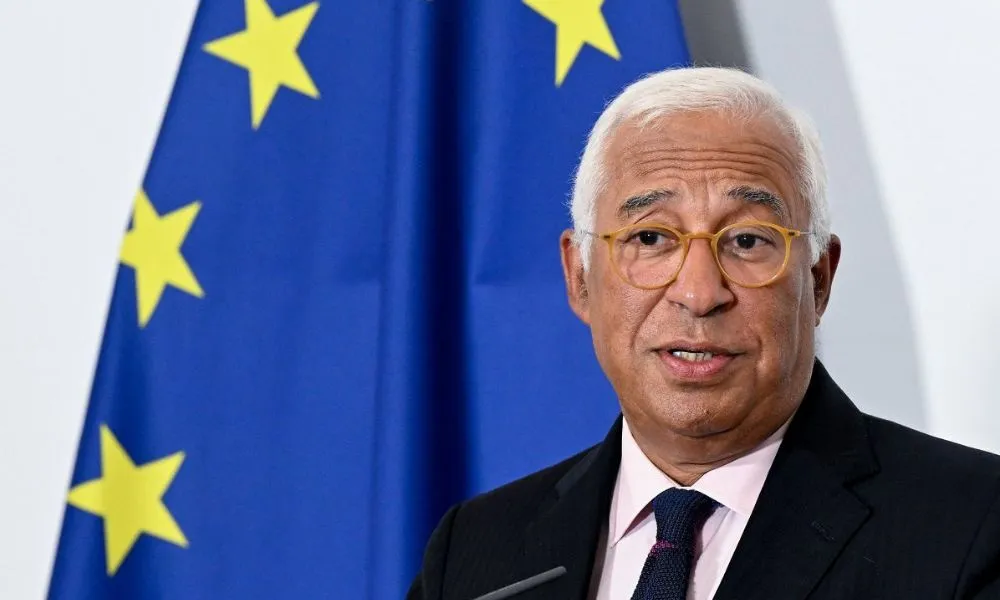

EU leaders discussed recent developments in transatlantic relations and their implications for the European Union on Thursday, with European Council President António Costa stressing that the objective remains the meaningful stabilisation of trade relations between the EU and the United States.
Speaking at a press conference following the informal meeting of European Council members, Costa underlined that relations between partners and allies must be managed in a spirit of cooperation and mutual respect.
Arctic security and the EU’s role
Costa noted that Europe and the United States share a common interest in the security of the Arctic region, “particularly through cooperation within NATO,” adding that the European Union will also assume a stronger role in the area.
Referring to the Kingdom of Denmark and Greenland, the President of the European Council stressed that both enjoy the EU’s full support. “Only the Kingdom of Denmark and Greenland can decide on matters concerning Denmark and Greenland,” he said.
He added that this position reflects the EU’s firm commitment to the principles of international law, territorial integrity and national sovereignty, which he described as essential not only for Europe but for the international community as a whole.
No new US tariffs, but vigilance remains
Costa also welcomed the announcement that no new tariffs will be imposed by the United States on Europe, describing this as a “positive development.”
He stressed, however, that the imposition of additional US tariffs would be incompatible with the EU–US trade agreement. “Our focus must now shift to promoting the implementation of this agreement. The goal remains the substantive stabilisation of trade relations between the European Union and the United States,” he said.
At the same time, he made it clear that the European Union will continue to defend its interests and protect itself, its member states, its citizens and its businesses from any form of coercion. “The EU has the strength and the tools to do so, and it will act whenever and if necessary,” he said.
Reservations over the Peace Council
Costa also pointed out that the EU has serious reservations regarding certain elements of the statute of the Peace Council, “particularly with regard to its scope, governance and compatibility with the United Nations Charter.”
At the same time, he expressed the EU’s readiness to work with the United States on the implementation of a comprehensive peace plan for Gaza, with a Peace Council acting as a transitional administration, in line with UN Security Council Resolution 2803.
Strategic autonomy remains a priority
The European Council President reiterated that the EU remains focused on delivering an ambitious agenda for its citizens, centred on defence, competitiveness and the construction of a more strategically autonomous Europe.
He added that the next meeting of EU leaders, scheduled for 12 February, will focus on a strategic exchange of views aimed at strengthening the Single Market within a new geo-economic framework.
Von der Leyen: EU better positioned after latest developments
European Commission President Ursula von der Leyen said that the European Union is now in a stronger position regarding the Greenland issue, just 24 hours after the latest developments.
Speaking at a press conference on the margins of the informal leaders’ meeting, von der Leyen said discussions among EU leaders had allowed the Union to draw critical lessons from its collective strategy, which she said was based on four main pillars.
Four pillars of the EU response
According to von der Leyen, the first pillar was the clear and unequivocal expression of solidarity with Greenland and Denmark. The second was the EU’s firm support for the six member states that faced threats of tariffs, alongside active and multi-level diplomatic engagement with the United States.
The third pillar involved very active engagement with the US at multiple levels. “We did so in a firm but non-escalatory manner,” she said. The fourth pillar concerned EU preparedness, including trade countermeasures and non-tariff tools, should tariffs have been imposed.
Summing up, von der Leyen said the EU followed four guiding principles: stability, engagement, preparedness and unity.
Renewed focus on the Arctic
Von der Leyen made special reference to the Arctic, noting that the region and its security have long been underinvested. She said the time is now right to step up efforts, recalling that the EU office in Nuuk was inaugurated two years ago and that agreements signed last year have paved the way for new investments in clean energy, critical raw materials and digital connectivity.
She added that the European Commission has already proposed doubling financial support for Greenland under the EU’s next multiannual budget and is preparing to present a substantial investment package in the near future.
At the same time, the EU plans to strengthen cooperation with the United States and regional partners on Arctic security, focusing on equipment suited to the region’s specific conditions and on closer defence ties with countries such as the United Kingdom, Canada, Norway and Iceland.
Ukraine and European independence
Turning to Ukraine, von der Leyen said Russia is intensifying its attacks, with the EU responding by further strengthening its support for Kyiv. She announced that 447 emergency generators, funded with €3.7 million, are being deployed this week to restore electricity to hospitals, shelters and critical infrastructure.
She also said progress is being recorded both on security issues and on prosperity packages linked to peace talks. According to von der Leyen, security guarantees discussed, including at the Paris meeting on 6 January, have advanced, with the EU now awaiting a response from the Russian side.
In closing, the Commission President stressed that European independence is more critical than ever, noting that EU leaders will meet again at an informal summit on 12 February to further advance this strategic objective.