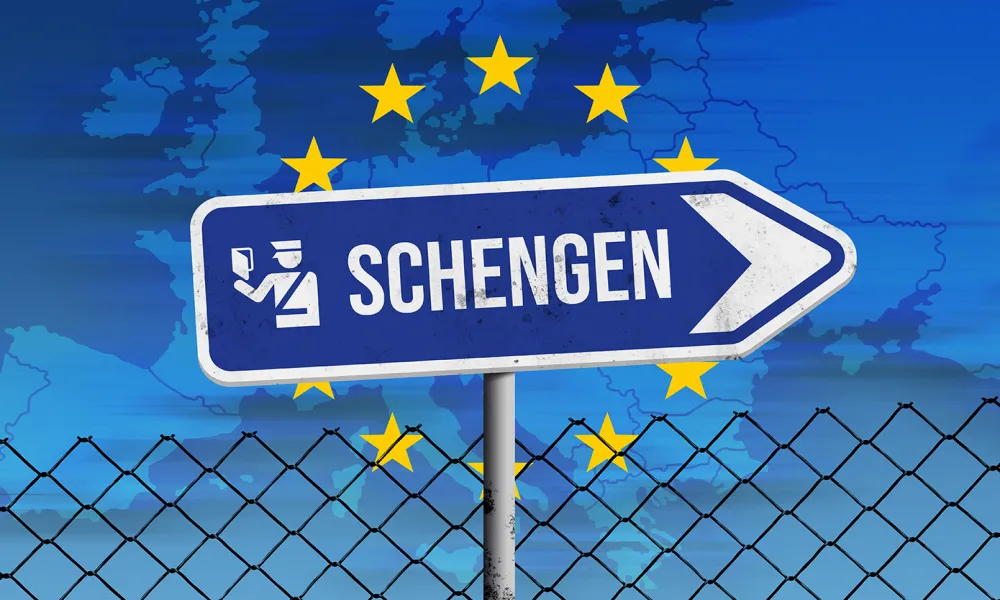

The fact that the Republic of Cyprus wants to become a member of the Schengen Area is a given. The real question is whether, during its own presidency of the Council of the European Union in the first half of 2026, it will be able to actively advance its accession, or whether it will be forced to accept that this cannot happen without either the reunification or the formal partition of Cyprus.
Will we manage to retain and strengthen foreign investment, or will our promises prove hollow? This is the real wager, not only of the year ahead but of the country’s modern history itself.
EU membership without participation in the Schengen Area effectively renders the Republic of Cyprus something less than an equal member. Cypriot citizens experience this every time they travel from Cyprus to destinations within the EU, including Greece, where airport authorities direct them to non-Schengen passport control queues alongside travellers heading outside the Union.
For the business community, however, the absence of Schengen status is far more than an inconvenience at airports. For Cyprus-based companies with foreign ownership in particular, exclusion from Schengen is seen, rightly, as a serious obstacle for their workforce, which often consists of third-country nationals. In practical terms, these employees become effectively confined to Cyprus, as they require visas for both professional and private travel within the EU.
During the pre-election period, the issue was raised repeatedly, with all presidential candidates committing to Cyprus’ accession to Schengen. President Nikos Christodoulides is now the one called upon to deliver on that promise. This is where his ability to demonstrate consistency between words and actions, particularly towards foreign investors, will be tested.
The problem, however, lies in whether this can be achieved without the reunification of Cyprus and without signing off, directly or indirectly, on its permanent partition.
From the helm of the EU presidency, Cyprus has a rare opportunity to reshuffle the deck and explore what the EU could offer Turkey, such as progress on the customs union and visa liberalisation, in exchange for EU oversight of controls at ports and airports in the occupied areas. Such an arrangement would ensure effective control over all points of entry and exit across the island and would, in turn, open the path to Schengen accession.
The question is whether this would be desirable for Turkish Cypriots, and how prepared the Republic of Cyprus is to allow, through a revision of the Green Line Regulation and formal identification mechanisms, the direct trade of the occupied areas.
This is a complex equation, particularly if the package does not also include guarantees for the island’s security, whether through the NATO-isation of troops stationed on the island or through demilitarisation, as well as arrangements concerning the buffer zone and the fenced-off city of Famagusta.
In other words, we are talking not necessarily about the resolution of the Cyprus problem, but certainly about its transition to a new phase, one that would likely lead, sooner rather than later, to a choice between reunification and permanent partition.
Can any President of the Republic take such a risk? The answer is undoubtedly yes. Not because they want to, but because the risk of permanent partition already exists. Within the framework of the EU presidency, Cyprus at least has a voice.
If not now, then when? Turkey will eventually unlock, with or without our consent, issues relating to visas and the customs union, and direct trade with the occupied areas is no longer as distant a scenario as it once was.
Now, therefore, is the moment for the President to return to the negotiating table for the Cyprus problem, or at the very least to take a decisive step by bringing the whole of Cyprus into the Schengen Area.
Special thanks for this article go to Eftychios and Grigoris, with whom the issue was discussed around the festive table.