Food remains one of the largest household expenditures in Europe, accounting on average for around 11.9% of total spending across the EU. In some countries, particularly in Eastern Europe, this share exceeds 20%, underscoring the importance of food prices for household finances.
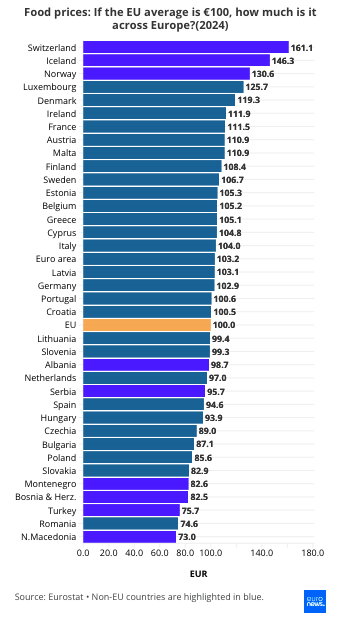
Eurostat’s food price level index compares the cost of a standard food basket across European countries, using the EU average as a benchmark set at 100. Countries scoring above this level are more expensive, while those below it are cheaper.
The Cheapest And Most Expensive Countries
In 2024, North Macedonia recorded the lowest food prices among 36 European countries, with a food basket costing the equivalent of €73, around 27% below the EU average. Within the EU, Romania had the lowest food prices at €74.6, while Luxembourg ranked as the most expensive at €125.7.
At the top of the overall ranking are Switzerland, Iceland and Norway, all non-EU members with notably higher food prices. Within the EU, food prices are also at least 10% above average in Denmark, Ireland, France, Austria and Malta.
Southeastern Europe Remains Cheaper
Countries in Southeastern Europe and the Western Balkans continue to record the lowest food prices. Besides Romania and North Macedonia, prices are well below the EU average in Turkey, Bosnia and Herzegovina, Montenegro and Bulgaria, while Serbia and Albania also remain cheaper than the European mean.
Where Cyprus Fits In
Cyprus falls closer to the higher-price group, following a pattern seen across much of Western and Southern Europe. While food prices on the island are higher than in many Central and Eastern European countries, experts note that price levels alone do not fully capture the impact on households.
Why Prices Differ Across Europe
Analysts point to structural factors such as production costs, supply-chain integration and exposure to global shocks as key drivers of price differences. Smaller and highly open economies, including Cyprus, have often been more affected by rising energy and agricultural input costs in recent years.
Labour costs play a central role, as countries with higher wages tend to have higher food prices due to increased costs in agriculture, processing and retail. Taxation also matters, particularly VAT on food products, which varies significantly across Europe. Consumer habits, including preferences for organic, premium or branded goods, further influence price levels.

Implications For Affordability And Food Security
Experts warn that food price differences have broader implications for food security. While higher-income countries can absorb higher prices more easily, households in lower-income countries face a heavier burden even when nominal prices are lower. Eurostat’s price index does not account for income or affordability, meaning that higher prices in wealthier countries do not necessarily translate into reduced access to food.
Source: Euronews