Redux
Every journey circles home
I drove up to Troodos last weekend with the guilty pleasure of someone who knows she deserves a break yet still wonders if she should apologise for it, because guilt is a burden women are taught to carry.
December in the media feels like Santa’s workshop and it feels like you are one of the overworked fairies who must earn every hour of leave. I had been invited to the Gender and Media Workshop organised by the Office of the Commissioner for Gender Equality which formed part of the National Strategy for Gender Equality. Still, I could not shake the suspicion that the organisers might have preferred someone younger or perhaps a man rather than a menopausal woman who insists on having opinions.
Cyclone Byron had dusted Troodos with a kind of Swiss charm and the scenery made me ask myself what new lesson could possibly await me:
I already know that our society is deeply patriarchal.
I know that a femicide, takes place every few minutes somewhere in the world and that equality that can be measured is rarely found unless the job involves caring, nursing, or cleaning.
I know that pay gaps persist and that our political representation remains among the lowest in Europe. I also know that no miracle will boost the number of female MPs after the May parliamentary elections. I know that change is slow, painfully slow…
In Troodos we discussed about how sexism is triggered and used as a tactic to silence women who speak up. Many times, I felt or made to feel that the discomfort I caused when expressing my views was my fault. In my age I see more clearly that challenging the status quo can tickle misogyny expressed as sexism. I had sensed the pushback but had not fully understood the mechanisms behind it or the ways others try to place me back where they think I belong.
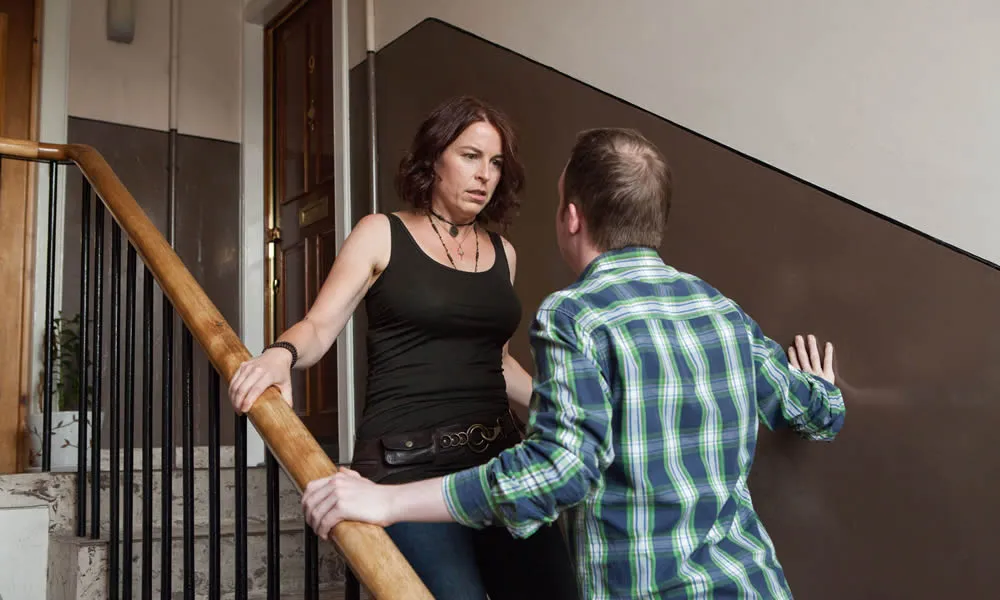
The workshop’s trainer Maria Angeli guided us through the ways images shape narratives. We examined familiar stock photos used to illustrate reports on femicide. The woman crouched in a corner. The man towering over her. I learned that such images only reinforce the idea that women are weak and frightened while men are strong and inevitable. In reality many victims fight hard before they ever reach that corner. There are image banks like unsplash and zero tolerance that show women who resist and women who look like real human beings including women who look like me. Journalists should use them and encourage other colleagues to do so.
We discussed language too and how Greek grammar traps us inside gendered structures. Many nouns in Greek are inherently gendered, such as μαθητής (male student) and μαθήτρια (female student). The form μαθητ@ uses the symbol @ to create a neutral, inclusive option, intentionally avoiding the strict male/female distinction. This allows the word to refer to anyone, including non-binary or gender non-conforming people.
This is a sensitive issue for Greek speakers because we treat our language as something sacred and unalterable, as if some languages deserve to evolve while ours must remain frozen in time. And I can promise that linguists, language processors, and journalists will raise many eyebrows before we accept that language has always changed, will continue to change because people change and communication changes, and that it is okay.
In English, most nouns are not gendered, so inclusive language is usually achieved through strategies such as singular they/them pronouns (Each student should submit their work), gender-neutral terms (chairperson instead of chairman, firefighter instead of fireman, postperson, instead of postman), or creative spellings like Latinx to include all genders. In this sense, μαθητ@ functions similarly to these English strategies, signaling explicitly that all genders are included. These conversations are not abstract, because the way we use language and represent people in media shapes society for everyone.
Journalism is not about what feels familiar or personally important. You might think that in a society with real gender equality, symbolic gestures are unsignificant or completely unimportant. You may not care about inclusive words or about the new female silhouettes that appeared on pedestrian traffic lights in Nicosia, but indifference can shift overnight. If a trans person entered your family, you could find yourself moving from ‘I do not care’ to ‘I need to understand’ to ‘I must speak up’. Symbolic gestures become lifelines when the issue suddenly touches your home.
I left Troodos -after buying lots of hand cream and marmalade and small Zivanias from Kyperounta's Christmas market of local producers for my XMAS pressies- reminded that journalism is not literature. It does not need to be poetic. It needs to respect human rights.