
A Greek candidate sought and won the presidency of the Eurogroup, reportedly with an overwhelming majority of votes, according to initial information. It is a development that until a few years ago would have seemed unthinkable, perhaps even a joke, yet it is now a reality and reflects the progress made since the period of the fiscal crisis.
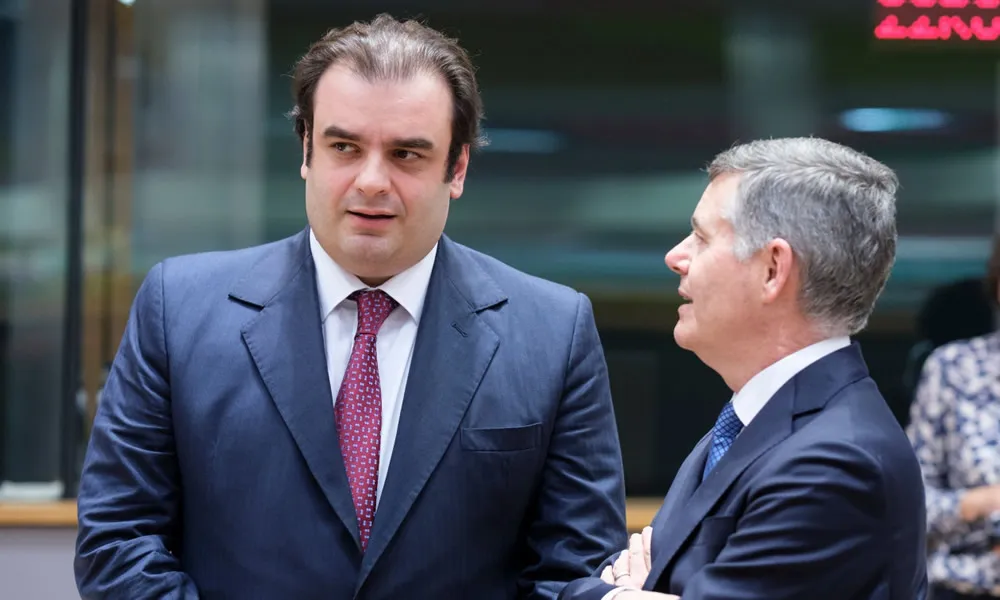
The election of Kyriakos Pierrakakis is also a personal achievement, as within only a few months of serving as Greece’s Minister of Finance he managed to gain the respect of his EU counterparts and is regarded as a suitable successor to Paschal Donohoe.
The position of Eurogroup president is not a simple role; it is considered highly influential, as demonstrated during the eurozone debt crisis.
The job description includes setting the agenda and chairing the monthly meetings of eurozone finance ministers for the next two and a half years, as well as representing the eurozone in international fora such as the G7 and G20.
The agenda Kyriakos Pierrakakis is expected to set
Kyriakos Pierrakakis’s proposal for the Eurogroup focuses primarily on economic reforms such as strengthening cross-border investments, reinforcing the single market, and ensuring that the digital euro supports Europe’s stability and strategic autonomy.
At the same time, the Greek Minister of National Economy and Finance has spoken of a eurozone that must operate more strategically in an era of global competition and rapid technological change. According to the report, this is an approach he successfully advanced in Greece and one he aims to bring to Brussels.
As he has noted, the challenge is not more analysis, but more action.
Who Is the New Head of the Eurogroup
Kyriakos Pierrakakis is a political scientist and computer scientist who assumed the position of Minister of National Economy and Finance in March 2025.
Before that, he served as Director of Research at the independent, non-profit research and analysis organisation “diaNEOsis”, Minister of State and Digital Governance, and Minister of Education, Religious Affairs and Sports. He also holds academic credentials from the Harvard Kennedy School and the Department of Informatics at the Athens University of Economics and Business.
From his position at diaNEOsis, he coordinated a series of research teams producing studies focused on the economic and productive reconstruction of the country. Earlier in his career, he worked at research institutes in Greece and abroad on issues related to digital policy.
This background proved useful in his role as Minister of State and Digital Governance, during which both the ministry and Pierrakakis himself received multiple distinctions.