Voice Across
We are once again told that Cyprus has entered a critical juncture. The phrase has been repeated so many times over the decades that it now triggers instinctive scepticism. Yet there is no alternative but to hope. For Turkish Cypriots, hope is not a luxury. It is as essential as breathing. On one side stands the existential threat posed by the Greek Cypriot majority’s unchanged dominance since 1963. On the other stands life within a state of their own that nevertheless resembles an open-air confinement shaped by international isolation. A third path forces young Turkish Cypriots to seek their future in the United Kingdom, Canada, Australia or Türkiye.
In such an equation, diplomatic movement naturally raises expectations.
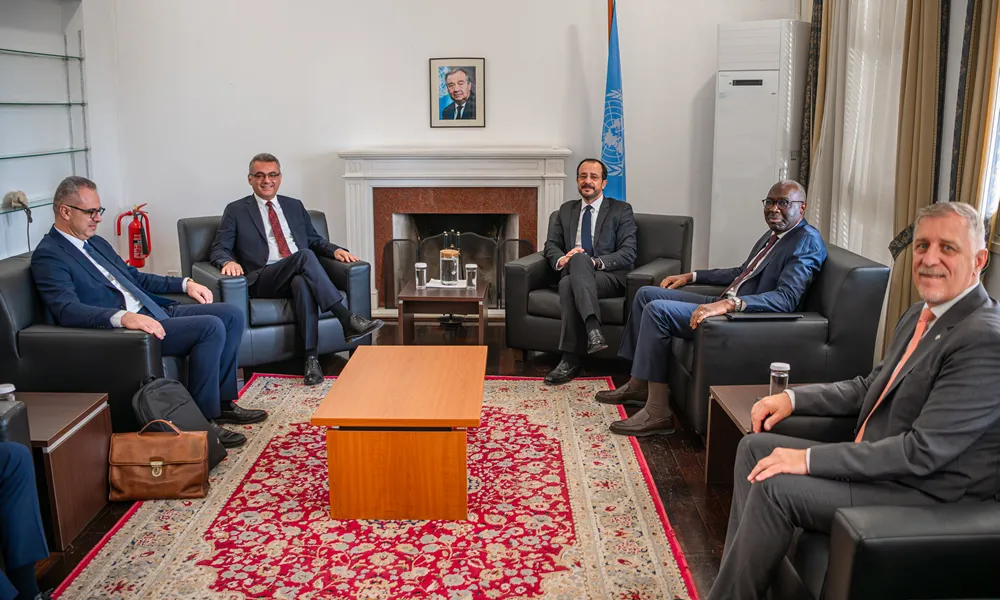
On 20 November, the two leaders met for the first time under the auspices of UN Special Representative Khassim Diagne in the buffer zone. The United Nations Secretary-General’s Personal Envoy for Cyprus, María Angela Holguín Cuéllar, is preparing to take over the process. The parties agreed to work toward a trilateral meeting before the end of the year, followed by groundwork for an informal multilateral encounter. There is a visible desire to open a new page. Yet the heavy shadow of the past rests on the table.
Greek Cypriot leader Nikos Christodoulides repeated his familiar line. Talks should resume from the point at which the Crans-Montana process collapsed. This is simply the latest version of the long-standing Greek Cypriot narrative: “We are the constructive side, failure is the responsibility of the Turkish side.”
The fourth condition
Erhürman, however, has set out a very clear framework, outlining four principles that must be accepted before meaningful talks can begin:
- Political equality will not be open to negotiation.
- The process will be strictly time-bound.
- Past convergences will not be discarded.
- If this process collapses, Turkish Cypriots will not return to the status quo and the international community will have to produce a new status, including options that end the isolation regime.
The Greek Cypriot side does not object to the first three.
The fourth, however, has triggered significant discomfort. This is because it threatens the comfort zone that the Greek Cypriot leadership has enjoyed for sixty years. The old assumption that “the world recognises only us, even if talks fail, we lose nothing and the cost is borne by the Turkish Cypriots” may no longer hold.
Greek Cypriot officials present the fourth condition as a disguised attempt to impose a two-state outcome. In reality, the issue is deeper. For the first time, the possibility arises that the side responsible for failure could face consequences.
U.S. & new strategic equation
Messages coming from Washington reinforce this possibility.
U.S. Ambassador to Türkiye Tom Barrack is not a career diplomat but a businessman and a long-time confidant of former President Donald Trump. That is why he occasionally says aloud what others would never voice.
In one appearance he revealed that Trump told him that President Erdoğan “needed legitimacy, and we provided it”. In another, he said that Türkiye and Greece’s disputes would be handled through a comprehensive package, with Cyprus serving as the key component.
What does this indicate?
• The Aegean and Eastern Mediterranean issues will be addressed together.
• Cyprus will play a central role in the package and cannot be ignored.
• Washington no longer considers the current status quo sustainable.
Greek Cypriots are not mistaken to feel uneasy. Trump’s approach to Ukraine is well known. Leaving Crimea and Russian-majority regions to Moscow and rebuilding Ukraine with seized Russian assets represents a mindset that rewards the powerful and offers financial incentives to the weaker side. If such logic is applied to Cyprus, the protective shield that Greek Cypriots have relied on for decades may weaken.
Erdoğan’s position and the two-state line
During Erhürman’s visit to Ankara, President Recep Tayyip Erdoğan sent a very clear message. Türkiye will not step back from the principle of sovereign equality and, although not stated directly out of diplomatic courtesy, continues to view a two-state settlement as the most realistic model. This position does not mean closing the door to negotiations. On the contrary, it pressures the Greek Cypriot side to move beyond its stagnant position of “either a federation on our terms or a continuation of the unitary state”.
Erhürman, meanwhile, has crafted his own balance. Although he did not mention federation during the Ankara meetings out of propriety, he keeps all models of settlement on the table, including a federal structure. His conditions are clear: the process must be targeted, time-limited and result-oriented. He refuses to enter another endless cycle where failure is predetermined and blame is placed solely on the Turkish Cypriots.
This is where the main divergence emerges. If Christodoulides is not genuinely committed to a solution and the process collapses again, it is clear that Turkish Cypriots will not return to the status quo. The international community will have to consider options such as direct trade, direct travel and direct contact. In other words, a path that leads to the lifting of isolations.
That is exactly what worries the Greek Cypriot leadership.
Holguín’s difficult assignment
This weekend, Holguín begins her shuttle diplomacy. She will first meet each leader separately, then proceed to a trilateral meeting next week, followed by visits to Ankara and Athens.
Her task requires:
• Anchoring Erhürman’s first three principles within UN parameters
• Developing, with the EU and UN, a mechanism that gives meaning and consequence to the fourth principle
• Managing the political sensitivities within the Greek Cypriot community
• Preventing the process from turning into another endless negotiation with no accountability
None of this is easy. Yet the UN signals that it does not intend to return to the old pattern of open-ended talks that go nowhere.
A false spring or a genuine turning point?
Within a few weeks, much will become clear.
• The leaders have met at the table for the first time.
• Holguín has launched a dense diplomatic effort.
• Washington views the issue through the lens of a broad regional package.
• Ankara supports a results-oriented model.
• The Greek Cypriot side is uneasy because of the “consequence clause”.
Viewed together, more elements appear aligned than at any time in recent memory.
I do not wish to sound pessimistic, but the recent history of Cyprus is filled with moments of rising hope that ended in disappointment. Will this process unfold as Erhürman envisions, with clear goals, time limits, respect for past convergences and mechanisms that produce outcomes even in the event of failure? Or will we again witness a false spring in which the Greek Cypriot side remains comfortable while the Turkish Cypriots are condemned to renewed isolation?
Hope is necessary. Yet one fact is now clear. If the process begins and collapses once more under the weight of old habits, the cost will no longer be imposed solely on the Turkish Cypriots.
Perhaps the moment of truth for Cyprus will emerge precisely at that point.