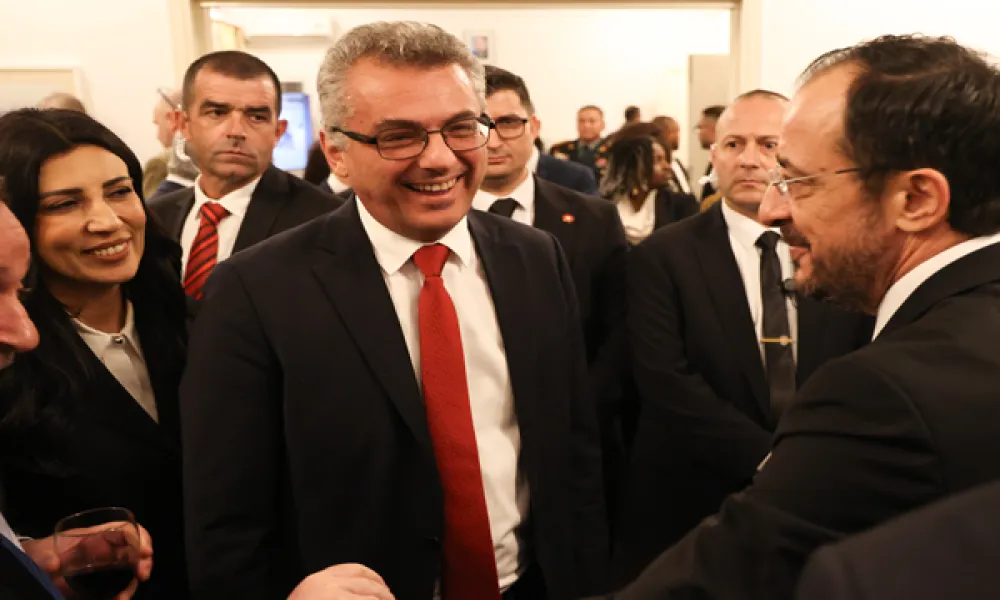
On Thursday (11/12) in Nicosia, the first tripartite meeting took place between the two Cypriot leaders, Nikos Christodoulides and Tufan Erhürman, on the Cyprus issue, under the auspices of the UN Personal Envoy, María Angela Holguín. The prospects for progress remain unclear. No agreement was reached on a new informal five-party meeting, and discussions on confidence-building measures stalled. Despite a positive atmosphere and a sense that “something is moving,” no tangible results emerged. Crucially, the question of who will break the strategic deadlock of eight years remains unanswered.
Federal Solution with Political Equality
The two leaders “agreed that the ultimate goal is to resolve the Cyprus issue through political equality, as outlined in UN Security Council resolutions.” This statement is useful mainly because it ends weeks of speculation about Erhürman’s objectives. Christodoulides presented it as significant: “It is the first time this has appeared in a statement since October 2020.”
However, this represents superficial progress. The concept of a federation with political equality was agreed in the 1980s, during Spyros Kyprianou’s era. In 1991, it was further detailed in an additional UN Security Council resolution. Over the decades, painstaking negotiations on political equality have taken place through various solution plans. In 2017, Anastasiades and Akıncı reached very specific convergences, recorded by the UN: a rotating presidency with weighted votes and universal suffrage, and effective participation of Turkish Cypriots in decision-making bodies to form majorities with minimal Turkish Cypriot consent.
It is entirely misleading - half a century later - to present as progress that “we want a federation and they want political equality,” as pro-government media in Nicosia reported.
The Real Question
The leaders were again asked by the UN to address a far more complex and advanced question: do they adopt the Guterres framework and its six points as the basis for final negotiations? Holguín is asking them to commit to continuing where the Crans-Montana talks left off and reach a strategic agreement. The UN’s intention is clear: the clock on the Cyprus issue will not be turned back.
Christodoulides was not forthcoming on this contentious matter. He may need time or prefer “talks without preconditions,” as his spokesperson K. Letympiotis recently reiterated. In contrast, Erhürman said there was “partial agreement” but stressed that, from the Turkish Cypriot perspective, the issue remains unresolved unless the rotating presidency is included. He also noted that “no discussion or proposal occurred regarding the guarantee regime.” The discussion, therefore, was intense, lasting nearly three hours.
Christodoulides may have shared more in private with party leaders at the National Council on Friday (12/12) than he publicly reveals. However, this carries risks, as parties such as DIKO, EDEK (officially in government), and ELAM (which supports him) oppose a federation with political equality and reject the Guterres framework.
Christodoulides must navigate this carefully in the two years remaining before the presidential elections. Without tangible progress, UN Secretary-General António Guterres is unlikely to relaunch full-scale negotiations.
Informal Five-Party Meeting
No breakthrough occurred on Thursday regarding a third informal five-party meeting. Guterres is also focusing on specific confidence-building measures (CBMs) that were allegedly agreed but never implemented: four new crossing points and a photovoltaic park in the buffer zone, funded by the EU.
The leaders agreed that “CBMs are important for creating a favourable environment but do not replace achieving a solution to the Cyprus issue.” The UN and EU are aware that the domestic climate in Cyprus is extremely negative and must change. Christodoulides acknowledged discussions on opening new crossings but said “no conclusion was reached; there is disagreement.”
In reality, discussions on new crossing points have completely stalled. The UN perceives that the Greek Cypriot leadership is unwilling to approve new crossings, while Erhürman links them to the next informal five-party meeting, creating yet another impasse that casts doubt on the sincerity of intentions.
Regarding more practical, everyday issues to facilitate citizens’ lives, Christodoulides presented ten proposals in response to eight submitted by Erhürman a month ago. On Thursday, the minimum consensus was reached: increasing staff at crossing points and easing Turkish Cypriot access to driver’s licences and insurance, and advancing certification of Turkish Cypriot halloumi.
These represent a narrow field of agreement and considerable tension. Erhürman seeks to “challenge” Christodoulides, who in turn aims to avoid being trapped in conditional negotiations. Holguín will travel to Greece and then Turkey before reporting to António Guterres with her routine update on Cyprus to the Security Council in early January. It is clear that without external intervention, the Cyprus issue remains deeply entrenched in inertia and prolongation.
EU Envoy’s Active Role
Noteworthy was the visit to Cyprus by the EU Envoy Johannes Hahn, who met both President Christodoulides and, on Friday, Tufan Erhürman. Unlike his predecessor Ersin Tatar, Erhürman has chosen to actively engage in the European arena, presenting a full Turkish Cypriot agenda: the Green Line Regulation, the status of Turkish Cypriots in the Schengen accession process, Cypriot—and thus EU citizenship for thousands of spouses and children of Turkish Cypriot parents, and unfreezing alignment of the Turkish Cypriot community with the EU. Erhürman also raised direct trade between northern Cyprus and the EU, highlighting that Turkish Cypriots should not remain isolated if talks collapse again due to Christodoulides’ position.
At the Presidential Palace, Hahn had a constructive discussion with President Christodoulides, who welcomed the EU’s involvement and urged it to help resolve the Cyprus issue: “We have lost two and a half years, and now is the time to discuss substance.” Hahn replied: “Indeed, I believe this is the time for results. After so many difficult moments, I believe there is now an opportunity—not the last, but a real opportunity.” Addressing Christodoulides directly, Hahn emphasised that “Europe relies heavily on you to build a good relationship with the leader of the Turkish Cypriot community, paving the way not only for resuming talks but for finding a definitive, positive solution to the Cyprus issue.”
Christodoulides responded: “Rest assured, if it were up to me, we would have succeeded.”
This article also appears in the Athens-based Efimerida ton Syntakton.