What is Changing in the Cyprus Issue?
Renewed Activity in Cyprus Talks
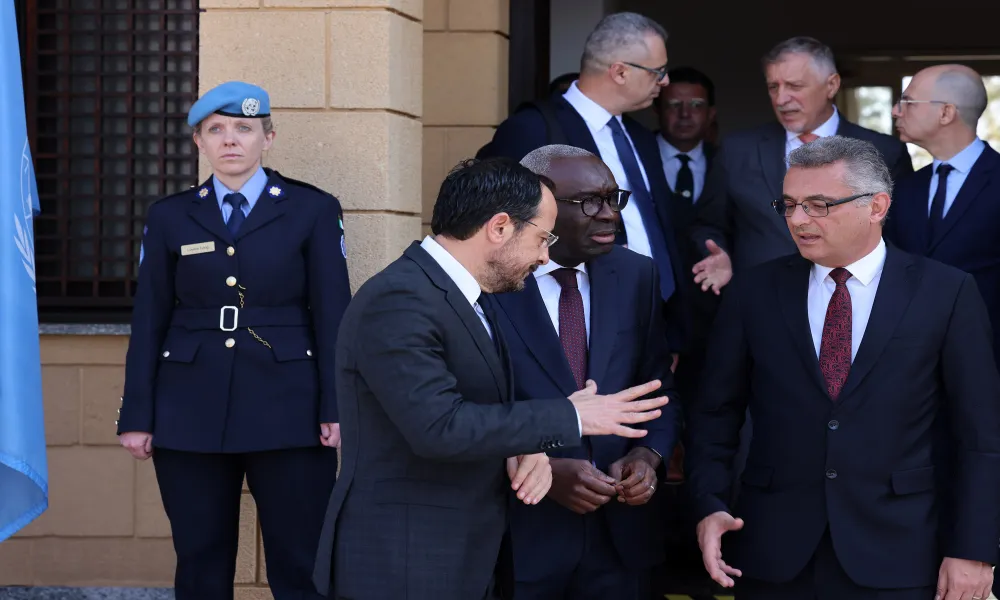
On Thursday, the area of the UN buffer zone near the abandoned Nicosia airport briefly attracted international attention. The Cyprus issue has entered a phase of renewed activity. Cypriot President Nikos Christodoulides met for the first time with the newly elected leader of the Turkish Cypriot community, Tufan Erhürman, and they agreed to intensify their contacts and preparations for an informal expanded meeting, the Five-Party talks, under the UN.
At the airport, they were welcomed by the UN Secretary-General’s representative, Hasheem Dean, a newcomer to the Cyprus issue but a close friend of António Guterres. Christodoulides and Erhürman exchanged views in a cordial atmosphere for about an hour and 30 minutes. Also present via videoconference was the Secretary-General’s personal envoy, María Ángela Olguín, who will soon visit the island.
Key Points
Without a doubt, this meeting revives previously lost hopes, but everything will now proceed very differently than in the past. The UN holds the key to the process and controls the timing, assessing explicit commitments rather than generalities. As long as António Guterres remains at the helm until the end of 2026, he will decide when and how full-scale negotiations will be convened. After an eight-year deadlock, no one internationally will invest in the Cyprus-owned talks dating back to 2008. Endless discussions will not happen again. The priority is result-oriented negotiations, as the UN repeatedly demands.
Another necessary change concerns the tone of the talks, which, according to both the UN and the EU, is currently the worst possible: complete distrust between the leaders and alienation of the two communities. From the perspective of an impartial observer, Cyprus seems trapped in its past, and its leaders are not thinking about the future, wrote María Ángela Olguín a year ago. Based on this, the renewed UN-led effort may take time to mature regarding the substance of the Cyprus issue, but much will need to be done on the ground to build trust. Confidence-building measures are now on the table.
In its brief statement, the UN recorded Christodoulides’ and Erhürman’s readiness to work toward the next expanded meeting and to explore other opportunities for joint meetings. This indicates that efforts will proceed on both levels: substantive issues and confidence-building measures.
Preparation
How prepared were the two Cypriot leaders on Thursday?
Returning from Nicosia airport, Christodoulides appeared satisfied, saying, "We are entering a process aimed at the main goal, which is the resumption of talks from where they left off at Crans-Montana." This shows his preference for the familiar model: leaders meeting in Cyprus, negotiators preparing the ground, with the prospect of evolving into full-scale negotiations. He did not speak in detail, stating, "we do not negotiate publicly."
The Turkish Cypriot leader, however, seems to approach this new phase differently. The first meeting with Christodoulides, though cordial, was structured, with minutes kept and UN representatives present. Erhürman submitted written proposals: first, regarding the methodology for substantive negotiations, and second, to create a positive atmosphere for conducting talks. He also held a press conference rather than informal statements to inform the public, having a fresh mandate on the Cyprus issue.
Methodology
María Ángela Olguín will return to Cyprus in December to focus on urgent matters. Christodoulides prioritizes substantive talks, but by referring to a resumption from Crans-Montana, he does not publicly clarify what he considers binding from past negotiations, including convergences and the Guterres framework. He may view it as part of the negotiation.
Now Erhürman explicitly proposes before the UN the acceptance of convergences, without reopening chapters or issues that have already been agreed upon in detail. He also links this to Christodoulides’ explicit acknowledgment of political equality. Inevitably, this will trigger intensive behind-the-scenes consultations before the issue reaches the informal Five-Party level. These will not face the intransigent positions previously held by Tatar, which had put Christodoulides in a difficult position.
A related and contentious question is whether full-scale negotiations, if convened by the UN, will be open-ended or have a specific timeline. Erhürman seems more prepared, following the Guterres logic of no endless talks. Christodoulides has not taken a public position but asked diplomat-negotiator Menelaos Menelaou to reiterate on Radio Politis the usual stance: extremely sensitive issue in the past did not work productively, therefore gradual progress and steps forward. Erhürman declares readiness for full negotiations but asks and seeks commitment on the status of the Turkish Cypriot community if the effort fails due to the Greek Cypriot leadership. Turkey also links its commitment to a settlement package, including security and guarantees, to a clause ensuring the Turkish Cypriot community’s exit from international isolation and not returning to the current situation.
Change in Atmosphere
Christodoulides avoided publicly commenting on Erhürman’s proposals to create a positive atmosphere. However, it is certain he will need to engage, as Guterres has set an agenda and homework for the Cypriot leaders, including opening four new crossings and establishing a photovoltaic park in the buffer zone.
In the first meeting, Erhürman also raised several concrete issues affecting the daily life of Turkish Cypriots but did not receive immediate responses from Christodoulides. He raised 10 points, most concerning hardships due to the division: easing crossing points, opening new lanes, children of mixed marriages, green line trade, halloumi trade.
Previously, Christodoulides and before him Anastasiades showed minimal interest, and the services were instructed to delay progress. The result today is accumulated dissatisfaction among Turkish Cypriots and reactions from the UN and the EU, which view the government’s stance as contradictory and incomprehensible.
Moving away from Tatar’s logic, Erhürman seems determined to also strongly appeal to Brussels. He seeks close relations of the Turkish Cypriot community with the EU, without obstacles imposed by the member state. Hence his call for the re-establishment of the ad hoc Joint Technical Committee for harmonizing the Turkish Cypriot community with the EU. This committee was unilaterally abolished by Anastasiades the day after Crans-Montana, with instructions to then-negotiator Andreas Mavroyiannis. Now, the issue will be raised with the EU envoy Johannes Hahn, whom Erhürman is willing to meet.