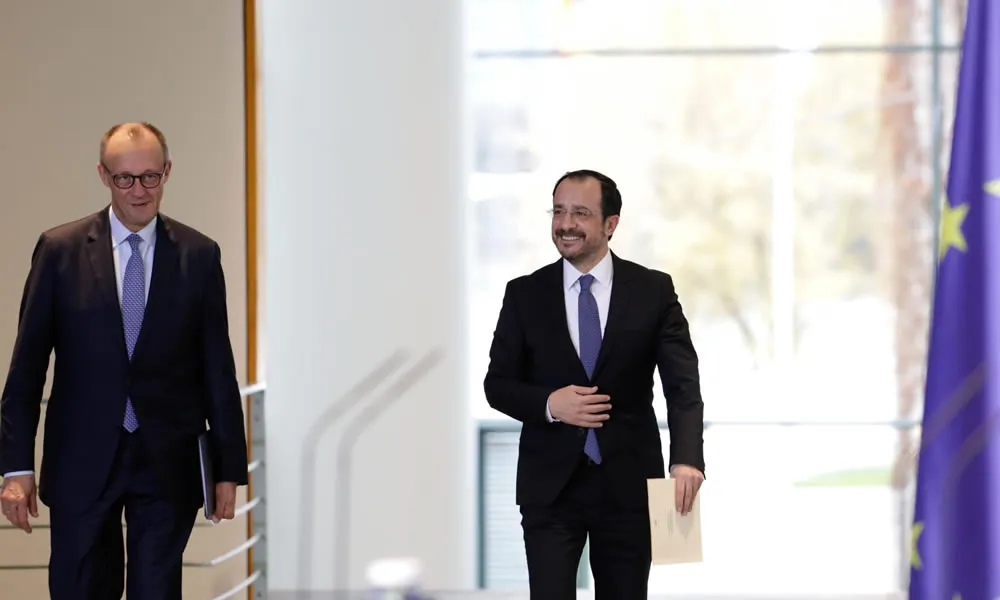
Cypriot President Nikos Christodoulides travelled to Berlin on 14 November for high-level talks with Chancellor Friedrich Merz. For the German side, the agenda centred mainly on the intertwined issues shaping their EU policy: the Cyprus problem and relations with Turkey, following Germany’s recent major opening towards Ankara.
Starting Point
The obvious question for any leader of a significant country in Europe’s current geopolitical climate is whether progress on the Cyprus problem is even possible. Many doubt it and avoid the topic, often relying on negative reports from their embassies. On the eve of his Berlin visit, Christodoulides faced a group of Financial Times journalists (12 November), who asked him precisely that question.
He replied that peace talks must resume following the recent election of Tufan Erhürman as leader of the Turkish Cypriots. Negotiations should pick up where they left off at Crans-Montana in 2017, he told the FT, adding: “We came so close… If we start from where we stopped, it is possible…”
The Greek Cypriot leadership is thus seeking a starting point after a long delay and without explanation. One might then ask why they left the table in the first place.
In this renewed effort, Christodoulides also called on the EU to step up: “This time, Brussels must also sit at the negotiating table. Only the EU could offer Ankara sufficiently strong incentives to reach an agreement.”
This approach is sound, but not new. Europeans were actively involved in the previous attempt and witnessed what transpired up to the final stage at Crans-Montana (Mogherini, Timmermans). Jean-Claude Juncker, then President of the Commission and a participant in Geneva (January 2017), later reflected on what went wrong: “I believe the main problem was not Erdoğan, and it was not Akıncı, but the south of the island, because it was not ready to take the leap.” He made this remark in a recent interview (29 May 2024), on the occasion of Cyprus’ 20th anniversary of EU membership.
No response
At Crans-Montana, “the parties had come close to a strategic agreement on security and guarantees, as well as on all other outstanding key elements of a comprehensive settlement,” wrote António Guterres in a report to the Security Council (September 2017). Yet no Greek Cypriot leader- neither Anastasiades nor Christodoulides - responded to his successive inquiries after the collapse: Where did we leave off? What do you accept from what was agreed? What binds you from the six-point framework I submitted at Crans-Montana (30 June 2017) for final negotiations? And so the opportunity was lost, and years went by…
Determination
On 13 November, the new Turkish Cypriot leader, Tufan Erhürman, travelled to Ankara to meet Erdoğan. The trip carried symbolic weight, reflecting the current relationship between the Turkish Cypriots and Turkey. More importantly, it showed how Erdoğan and Erhürman might approach the UN initiative. Erdoğan appeared to maintain his 2017 stance, criticising the Greek Cypriot leadership for a lack of interest in a solution. Yet he seemed to give Erhürman room to act at the negotiating table, backed by the strong mandate he received (63%), despite contrary speculations in Nicosia: “We would like to see the will of the Turkish Cypriots and the other side as well,” Erdoğan remarked.
Erhürman emphasises that the Turkish Cypriot side “has never left the negotiating table” and “intends to negotiate for the sake of a solution, not for the sake of negotiation.” The most critical issue he raises is what will happen in the event of another failure: “The Turkish Cypriot community will not return to the status quo in case of a new breakdown in negotiations due to the responsibility of the Greek Cypriot side.”
This issue arises prematurely for the UN. The Secretary-General still has a long way to go to rebuild the fractured negotiating framework. His envoy, Maria Angela Holguín, will hold separate meetings with the two Cypriot leaders and prepare a new informal five-party meeting under the Secretary-General. The unanswered questions will be raised again, but this time they offer no easy excuse. UN consultations will be more targeted toward Christodoulides’ side, now that Erhürman has returned to the federal framework. He will be called upon to answer regarding political equality - not general principles, but specifics: a rotating presidency elected jointly, and one Turkish Cypriot vote in every majority decision. Perhaps this is why Christodoulides is attempting to widen the range of open issues, though doing so complicates both the resumption of negotiations and their successful conclusion.
Small steps
Christodoulides has “bought enough time with Ersin Tatar” and now prefers small steps outside Cyprus. This logic also informs his approach to Turkey within the European Council (EC). In principle, he says: “I prefer a neighbour that will be close to the EU.” But in practice, he works toward the opposite, derailing relations with Turkey. He may even pursue this more rigidly than his predecessors. At the recent EC, he played the lead role in criticising Turkey for bypassing sanctions against Russia.
Cyprus has taught the EU to leverage its institutional position at every opportunity to block Turkey. Often it succeeds, forcing European partners to act bilaterally with Turkey on many issues, as is currently happening with defence and armaments. The paradox is that this strategy has yielded little benefit for the Cyprus problem itself: not an inch of occupied land, not a single property, not one Turkish soldier has departed.
Christodoulides now seems intent on …breaking the record for zero achievements in Cypriot diplomacy, proposing: “The EU and Turkey should take small steps toward building trust. We could start by lifting visas for Turkish businessmen. At the same time, Turkey could open a port for ships flying the Cypriot flag. Since 1987, no ship with a Cypriot flag has been allowed to approach Turkey.”
The Cypriot president speaks in the plural, as if representing common EU positions. He does this frequently, but most others - especially the stronger countries - do not follow this logic. In reality, they are deterred by the idea of entering a “give-and-take” with Turkey, which rejects it outright. If they persist, they anticipate multiplying complications in EU institutions rather than unblocking EU-Turkey relations: with each small step, Nicosia creates a new Cyprus problem, adding to the workload at COREPER.
Thus, at a time when discussions on abolishing unanimity are already intensifying in Europe, Brussels waits for a signal on the Cyprus problem from the UN.