
A new study from Frederick University’s H₂Zero Research Group sheds light on how energy communities can become a driving force in Europe’s clean-energy transition. While these citizen-led initiatives are designed to promote shared renewable production and lower energy costs, many are still planned using overly simple financial assumptions that fail to reflect real electricity-market dynamics.
This is where the new research steps in. Led by Professor Andreas Poullikkas, the team developed an advanced mathematical optimisation model that helps communities decide how much to invest in solar systems and energy storage—and under which market conditions those investments make sense.
Using genetic optimisation algorithms, the model evaluates investment strategies under realistic pricing scenarios. According to Prof. Poullikkas, this approach “accelerates the shift to renewable energy by giving communities the tools to design systems that work under real-world conditions rather than theoretical assumptions.”
Profitability depends on pricing
The study shows that the financial viability of an energy community is shaped primarily by one factor: the gap between the price at which it buys electricity from the grid and the price it receives when it exports excess production. This gap determines the investment size, the technologies chosen and the overall business case.
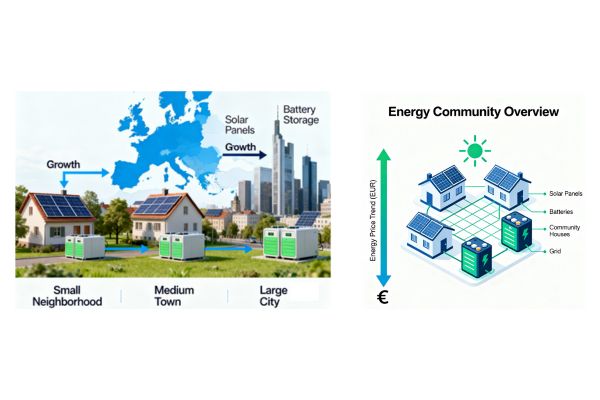
This finding underscores the importance of transparent, predictable electricity pricing. Without clear information on export rates and consumption costs, communities cannot make rational long-term decisions. When prices are accessible and reliable, strategies can be adapted to maximise returns for members.
Rethinking technology choices
A particularly interesting conclusion challenges a widespread assumption: that bigger storage systems automatically improve performance. The research shows that communities do not inherently favour storage. Instead, they invest in it only when pricing conditions justify the cost. More often, it is more profitable to increase photovoltaic capacity—taking advantage of free solar energy—especially when surplus power can be sold at favourable rates.
Storage remains a valuable tool, offering flexibility and better timing of energy use, but its capital cost means it must be used selectively rather than universally.
Market design is key
The broader message is clear. Effective energy-market design is essential for energy communities to thrive. With supportive regulation, fair pricing and access to modern planning tools, communities can become powerful accelerators of decarbonisation across Europe.
As Prof. Poullikkas puts it, “Energy communities are the democratisation of Europe’s energy transition. With the right pricing policies and simplified regulatory frameworks, they become attractive investment opportunities that strengthen resilience and energy independence.”
The study highlights a path forward: one where informed citizens, transparent markets and smart modelling converge to unlock the full potential of community-led renewable energy.