
The EU is moving forward with one of its most significant road safety reforms in recent years: a unified framework of penalties and rules that will apply across all member states.
For the first time, a serious traffic offence or the loss of a driving licence in one EU country will automatically carry the same consequence across the entire bloc. The long-standing loophole that allowed offenders to “escape” consequences simply by returning home is now closing for good.
According to the latest figures published by the European Commission, 19,940 people lost their lives in road crashes across the EU in 2024. Despite a modest 2 per cent decrease from the previous year, progress remains slow and far from the Vision Zero objectives: a 50 per cent reduction in road deaths by 2030 and zero fatalities by 2050.

Speaking on Tuesday, European Commissioner for Sustainable Transport and Tourism, Apostolos Tzitzikostas, underlined the urgency: "Today marks a major step forward in modernising our driver's licencing system and bringing down the unacceptable number of road deaths across the EU. Every life lost on our roads is one too many."
A single European penalty system
The cornerstone of the new legislation is the EU-wide mutual recognition of driving bans. If a driver loses their licence in France, Germany or Greece, that ban will apply automatically in Cyprus as well. Violations will follow the driver across borders, closing a long-standing safety gap that allowed dangerous behaviour to remain unpunished once someone crossed into another jurisdiction.
The reform also strengthens the exchange of data between member states, ensuring that penalties and disqualifications are recorded immediately and consistently in all European registers.
What changes for new drivers
The legislative package introduces several measures targeting young and inexperienced drivers:
• A pan-European accompanied-driving scheme for 17-year-olds, with specific supervision and safety conditions.
• A probationary period for new drivers, including stricter rules and potential additional sanctions for serious offences during the first years on the road.
• A fully digital driving licence, stored on smartphones and valid across all EU member states.
• Stricter requirements for drivers of alternative-power vehicles, such as electric or hydrogen-powered cars, which call for specialised training.
These changes aim to bring younger drivers into a safer and more consistent framework from the very beginning of their driving experience.
Cyprus road safety figures highlight key vulnerabilities
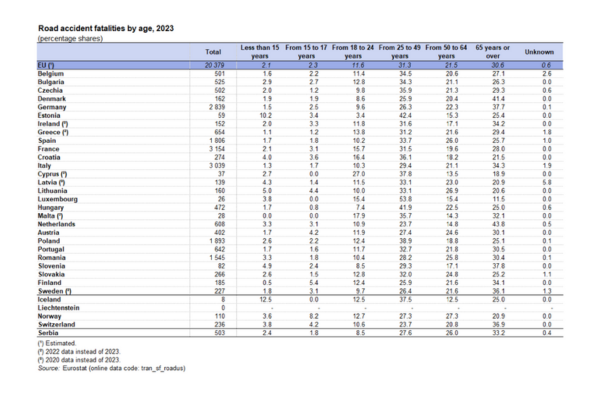
Cyprus’s latest road safety indicators, drawn from Eurostat’s 2023 and 2022 datasets, show distinct patterns in the distribution of fatal accidents across age groups, locations and gender. The figures place Cyprus among the countries with the most concentrated risks in specific demographic and road-use categories.
- Cyprus recorded the highest share of road fatalities among 18–24-year-olds in the EU, at 27.0 per cent (2022 data).
- Cyprus had the highest proportion of fatalities on urban roads, at 67.6 per cent (2022 data).
- In Cyprus, men accounted for more than 80 per cent of road fatalities in 2023.
Safest and least safe roads in the EU
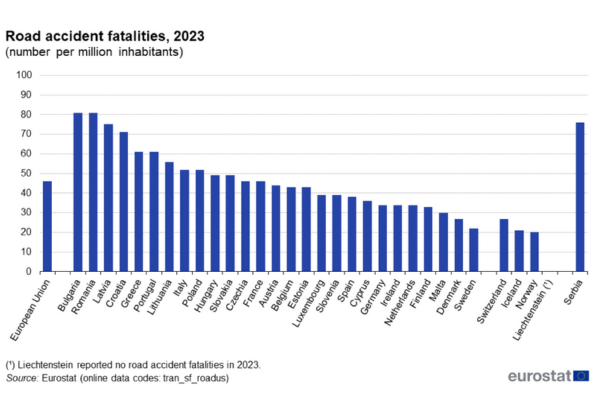
Sweden remains the safest country in the Union, with 20 deaths per million inhabitants, followed by Denmark at 24 per million. Romania and Bulgaria continue to record the highest fatality rates, at 78 and 81 per million respectively. Cyprus recorded an estimated 35 to 36 deaths per million inhabitants in 2023, placing it below the EU average of 46 per million and among the countries with relatively lower fatality rates.
When the measures take effect
The legislation is already in force at EU level. Member states, including Cyprus, now have up to four years to fully integrate the reforms into national law. Some provisions, such as the rules for alternative-power vehicles and the accompanied-driving system, will be activated earlier.