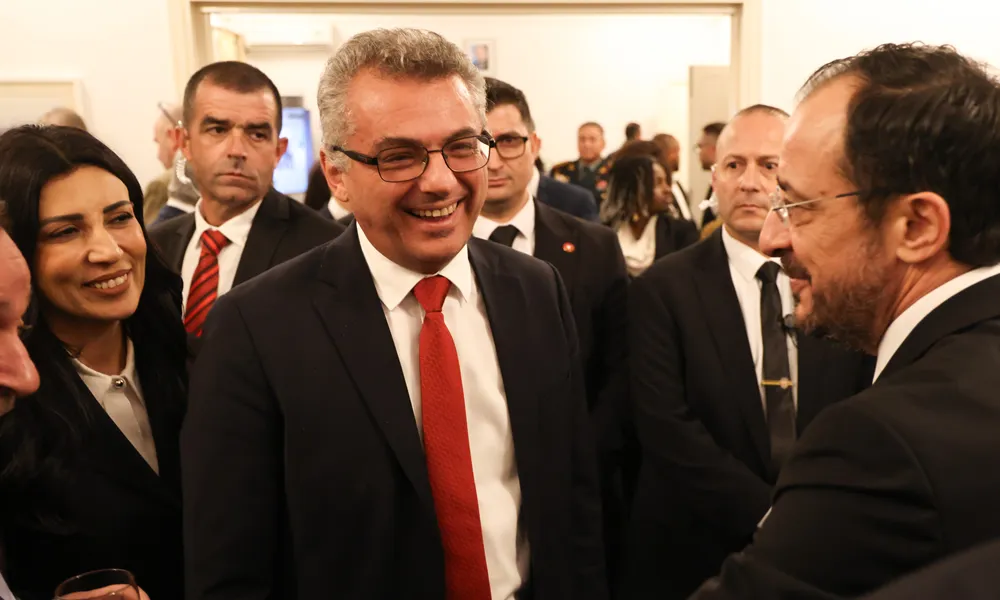
A new year dawns in the region and Cyprus is no closer to ending its stubborn division or reuniting its lands and people. Following the short-lived enthusiasm of Tufan Erhürman’s election, the relevant actors are beginning to show the usual signs of reluctance to take big leaps forward.
Keeping the wheels of dialogue greased
After Ersin Tatar’s two-state model brought stagnation to the peace process, the international community sought to keep dialogue alive, leading to informal expanded ‘5+1’ meetings with the guarantor powers, hosted by UN Secretary-General Antonio Guterres.
The first was held in Geneva in March 2025, where six confidence-building measures (CBMs) were agreed, half of which remain pending. A second ‘5+1’ followed in July in New York. New low-level trust-building initiatives were identified, with half also remaining pending.
‘Lawfare’ and the absence of compromise
Around the same time, intercommunal relations took a hit when the property ‘lawfare’ intensified. The Turkish Cypriot authorities arrested five Greek Cypriots on seemingly thin charges in an apparent tit-for-tat response to the Cyprus Republic’s prosecution of foreign nationals connected with the sale of Greek Cypriot properties in the north.
In his farewell interview with Politis, outgoing UN Special Representative Colin Stewart said the unwillingness of both sides to compromise was the biggest obstacle to a solution. He blamed this on the one-sided, historic narratives of victimhood that each side perpetuated. The one-upmanship, where one gains at the expense of the other, displayed by the sides made CBMs just as hard to achieve as a comprehensive solution, he noted.
A new wind blows
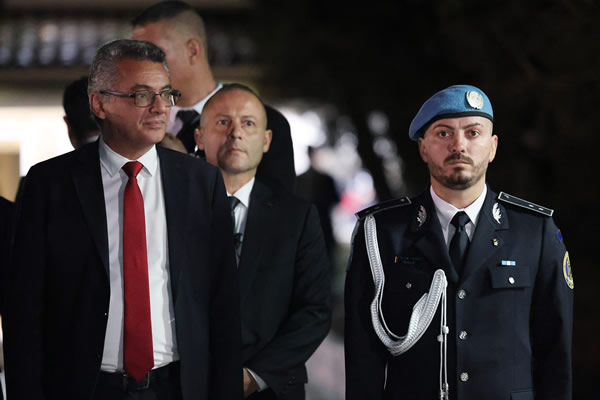
The overwhelming first round election victory of Tufan Erhürman on October 19 – with 63% of the vote – brought hope of change. Erhürman ran on a pro-federal ticket. But the somewhat introverted lawyer now had a mountain to climb to re-engage with the Greek Cypriots and overcome Ankara’s reluctance towards federal negotiations – fully aware that his constituency felt stuck between both.
To avoid a repeat of past failures, Erhürman set out to redesign the process, introducing four proposals to restart negotiations: agree on political equality from the outset, set timeframes, confirm past convergences, and ensure no return to the status quo should talks collapse.
The first leaders’ meeting was held on November 20 in a positive climate. The two discussed the future basis of the talks and new trust-building initiatives. No mention was made of a two-state solution.
Regional stirrings
A week before the first leaders’ meeting, Christodoulides met with German Chancellor Friedrich Merz in Berlin, asking his help to engage in a quid pro quo with Turkey which would see EU-Turkey relations improve in parallel with positive moves on Cyprus. At the same time, Greece and Cyprus discouraged Turkey’s involvement in the EU’s rearmament programme SAFE.
A week after the Christodoulides-Erhürman meeting, Cyprus and Lebanon signed a revised maritime delimitation agreement, drawing the wrath of Ankara and the dismay of the Turkish Cypriot leader.
The period also saw US President Donald Trump intervene in the Middle East to secure a ceasefire in Gaza and intensify efforts to end the war in Ukraine. His cosying up to Recep Tayyip Erdoğan, support for Turkish troops in Gaza, and pressure on Ukraine to cede sizable territory to Russia raised alarm bells in Nicosia about what a Trump-mediated Cyprus solution could look like.
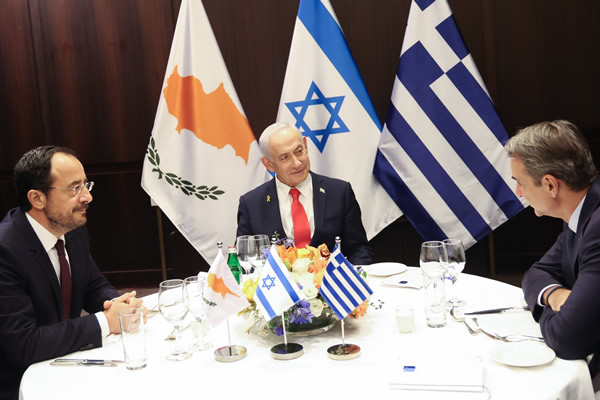
In late December, Christodoulides met with Greek premier Kyriacos Mitsotakis and Israeli Prime Minister Benjamin Netanyahu in Jerusalem. In the run-up, media reports suggested the three countries would set up a rapid reaction force in the region, prompting a denial by Defence Minister Vasilis Palmas. During the trilateral press conference, Netanyahu engaged in a spot of grandstanding at Turkey’s expense, suggesting the three “genuine democracies” would act as a bulwark against Turkish ambitions in the region. The event did not go unnoticed in Ankara. Nor did Israel’s recognition of Somaliland. Turkey’s sense of irritation and exclusion from strategic regional plans is real, and the likelihood of a dynamic response from Ankara is palpable.
First trilateral
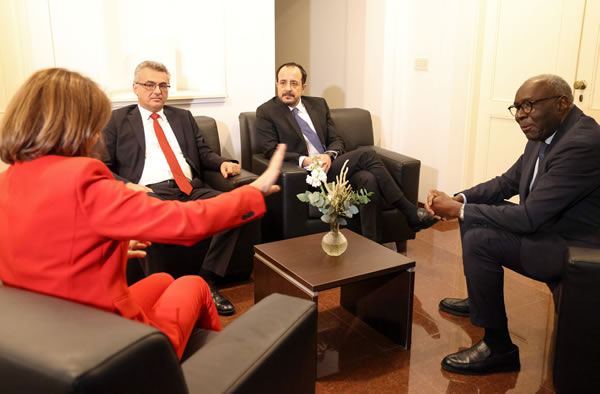
On December 11, Christodoulides and Erhürman met for the first time in the presence of UN Personal Envoy María Angela Holguín Cuéllar, for over three hours. They agreed that the real aim is a solution based on political equality as described in UN Security Council Resolutions. The outcome gave both leaders space to manoeuvre without upsetting coalition partners on the one side or Ankara on the other.
At the same time, the EU’s Special Envoy for Cyprus Johannes Hahn came to town, meeting with both leaders and Holguín separately. His message was the time had come to deliver. He encouraged the leaders to see compromise as an investment, not a concession, and intimated that the EU was ready to support and bankroll CBMs and a solution.
After the trilateral, Holguín went to Athens and Ankara to meet with the respective foreign ministers. After meeting Hakan Fidan, it became obvious the talks would not resume any time soon.
Where things stand
On CBMs, the leaders are no closer to agreement on the big issues like opening crossing points or the solar energy park than they were before. Discussions continue.
On reconvening the 5+1 meeting, Erhürman argues the sides need to make progress in Nicosia first. Sensing Ankara’s disinclination to engage, and its increasing impatience with Cyprus’ geopolitical involvement, Holguín echoed the view that the leaders need not rush to attend a new enlarged meeting. She called for careful preparation, clear sequencing and tangible convergences on the ground. She also urged the leaders not to waste time negotiating the technical details of CBMs, leaving that to their representatives, and instead focus on substance and taking strategic decisions. In other words, show intercommunal progress first, then invite others to join.
On substance, at first glance, little separates the leaders from agreeing to resume talks. On political equality, convergences were reached on a rotating presidency and effective participation at the trilateral meeting with Guterres in Berlin in 2019. Both leaders talk of adopting past convergences. The biggest wrinkle is how to approach the question of what to do if the talks fail, but this is not insurmountable.
What’s really lacking at present is the political will to take steps forward on CBMs and substance. Instead, we see hesitation and caution. We also see, on the Greek Cypriot side, an effort to play regional geopolitics and the EU card. The prospects of Turkey playing that game to Nicosia’s liking are limited.
On the Turkish Cypriot side, Erhürman is clearly walking a tightrope. He has yet to trust Christodoulides. And despite the strength of his election victory, he has yet to convince Ankara about a federal solution.
What to expect in 2026
The next confirmed steps for the new year are: Cyprus takes over the EU Presidency in January; parliamentary elections held in May; Turkish Cypriot local authority elections in December; Guterres steps down by the end of the year.
Potential steps in 2026 include: another trilateral meeting with Holguín followed by more leaders’ meetings; early Turkish Cypriot ‘parliamentary’ elections in March-May; a new 5+1.
None of the above rules out a resumption of talks in 2026 but it would require careful handling and a spot of good fortune.