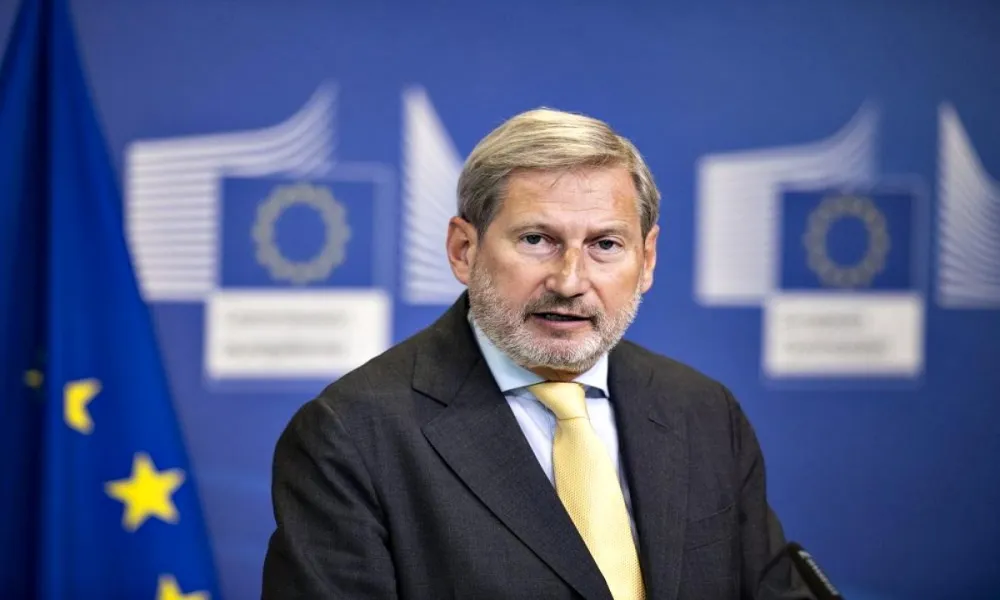

In this wide-ranging interview with the European Commission’s Special Envoy for Cyprus, Johannes Hahn, the European Union signals a renewed push to help break the Cyprus stalemate. Speaking to Politis after his recent visit to Cyprus, the EU Special Envoy sets out how Brussels intends to work hand-in-hand with the United Nations to engage both communities, build trust, and keep the prospect of reunification firmly anchored in the EU framework.
Hahn makes clear that Cyprus is not a marginal issue but a critical one, concerning EU values, effective policy implementation and stability and security in the Eastern Mediterranean. He signals readiness to engage with all key actors, including Turkey, stressing that improved EU-Turkey relations and progress on Cyprus can reinforce each other. Hahn welcomes the commitment of Turkish Cypriot leader Tufan Erhürman to seek a settlement within the UN framework and underlines the EU’s willingness to deploy its full toolbox, from confidence-building measures (CBMs) to targeted financial support.
The EU Special Envoy highlights the importance of achieving a sustainable solution that sees a reunified Cyprus as a viable EU Member State, where both communities can prosper. While the solution must be UN and EU-aligned, this still leaves considerable room for flexibility, he notes.
Reunification, he argues, is both politically feasible and economically transformative. From Green Line trade and Halloumi/Hellim PDO implementation to EU law compliance, green projects and future EU budget provisions, the EU is already preparing the ground. Hahn calls on the leaders to see compromise as an investment – not a concession – that would benefit all Cypriots. His message is unequivocal: it’s time to deliver a solution.
Interview with EU Special Envoy for Cyprus Johannes Hahn
How can the EU contribute towards bringing the sides to the negotiating table?
The Cyprus situation is a very important issue for the European Union as a whole, the effective implementation of its policies and promotion of its values, as well as for the stability and security in the Eastern Mediterranean.
The whole island is, and will remain after a settlement, part of the EU. The appointment of a Special Envoy reflects the EU’s intention to strengthen its political engagement and its support for a comprehensive settlement.
I was appointed Special Envoy to contribute to the settlement process within the United Nations framework, in close cooperation with the UN Secretary-General’s Personal Envoy on Cyprus, María Ángela Holguín Cuéllar.
My mandate is to engage with the Greek Cypriot and Turkish Cypriot communities to find convergences. I expect all parties to be constructive and committed to reach a sustainable settlement. I know that overcoming differences and lack of trust is challenging. But we need to focus on the future. It’s time to deliver!
What is your understanding with the UN Personal Envoy on the practicalities of your collaboration?
My mandate is clear: it is to contribute to and facilitate the UN-facilitated settlement process, therefore any engagement is carried out in close cooperation with the UN Secretary-General’s Personal Envoy on Cyprus. We share with the UN the goal of building trust between the two communities and finding a sustainable solution for Cyprus.
The Commission has long experience on the island, it has carried out peace-building and bi-communal projects for years. The contribution of the EU is also important for creating the right conditions for a workable solution in line with the EU framework.
What will be your approach to working with Turkey? Will you utilise EU-Turkey relations to encourage Ankara’s alignment with a federal solution?
My mandate is to constructively engage with all parties. I am ready to engage with interlocutors from Türkiye and regret that such discussions have not yet taken place. I continue to remain ready for dialogue.
Türkiye is an important player in the Mediterranean and partner for the EU. Improving EU-Türkiye relations can benefit the discussion on finding a settlement for the Cyprus issue and vice-versa.
What will be your approach to the Turkish Cypriots? How will you address the view on the Turkish side that, with the Cyprus Republic as a member, the EU cannot play the role of honest broker?
I look forward to the positive contribution of the new Turkish Cypriot leader in the ongoing process launched by the UN Secretary-General. I welcome the commitment of Mr. Tufan Erhürman to seek a settlement within the UN framework, and I was glad to meet him during my mission. The Commission is ready to support the process with all tools at its disposal, including by fostering and financing confidence-building measures.
The Union has a clear interest in seeing a reunified Cyprus as a viable Member State, where both communities can prosper. The EU has demonstrated, also in past negotiations, that it can contribute positively to the discussion on the settlement of the Cyprus issue to the benefit of both communities. My aim is to do the same.
In my three mandates as Commissioner I have many times proved to be impartial and committed to find a pragmatic solution with all parties.
What contribution can the EU make on the content of a settlement that would help bring the sides closer to agreement?
It is difficult to outline specific proposals at this stage as formal negotiations have not yet started. Of course, we know that the settlement should be found within the UN-agreed framework, on the basis of a bicommunal, bizonal federation with political equality, in accordance with all relevant UN Security Council resolutions and in line with the principles on which the EU is founded and the acquis but this leaves quite a lot of flexibility.
For the moment, we are focusing on supporting the UN-led informal process and working on implementing our own confidence-building measures (CBMs). These include, for example, the full implementation of the all-island Halloumi/Hellim Protected Designation of Origin (PDO) scheme, for which the pending administrative steps are expected to be resolved soon. The EU also facilitates Green Line trade and, in October 2023, launched a One-Stop-Shop to support Green Line trade and businesses from both communities with expertise and practical assistance. There are also ongoing discussions about developing a bi-communal solar power plant in the buffer zone, which is a Commission initiative that the EU would co-finance. The EU is also willing to explore financing the potential CBMs that the two leaders have identified with the UN Secretary-General if they agree to implement them.
Is full implementation of the Acquis Communautaire non-negotiable?
Member States have a clear duty to implement the EU acquis in full. As set out in the Treaty on European Union, through the principle of “sincere cooperation”, Member States must adopt all the necessary national measures to implement legally binding Union acts.
Will you work with the Turkish Cypriot community to prepare for EU harmonisation before a settlement?
Work in this area is already ongoing. One of the objectives of the EU’s Aid Programme for the Turkish Cypriot community is to contribute aligning the legal texts with the EU acquis, in view of a comprehensive settlement of the Cyprus problem. To this end, the EU is mobilising legal experts who assist the Turkish Cypriot community, ensuring that legal texts prepared are compliant with EU law. In addition, Aid Programme projects often support wider EU priorities such as the green transition and environmental sustainability. More will need to be done closer to the reunification.
What financial incentives is the EU offering for a solution – both in terms of current support (e.g. CBMs) but also for a final settlement?
The EU’s key instrument to facilitate Cyprus’ reunification is the Aid Programme for the Turkish Cypriot community, which is currently an average EUR 34.4 million per year. The measures are aimed at paving the way to reunification, but also getting the Turkish Cypriots as ready as possible for the moment of reunification – by narrowing economic disparities between the two communities, providing the Turkish Cypriot community with environmental infrastructure and aligning their products with EU standards, to mention just a few fields of actions. These projects includes significant support for confidence-building measures, which often combine several goals, such as Green Line trade, which is also an economic opportunity for all Cypriots.
The reunification will bring great economic benefits to the whole island, including in terms of investments. The Commission’s proposal for the next EU long-term budget 2028-2034 contains a provision stating that, in the event of Cyprus’ reunification, the EU budget should be revised to reflect the settlement and the additional financial needs resulting from reunification.
What message(s) do you have for the relevant actors involved?
We are at a promising juncture. The Leaders of both communities have declared their commitment to a resumption of negotiations within the UN framework. Both should see the movement towards each other as an investment, not as concessions. Focusing on finding compromises and overcoming divergencies is the way forward to deliver in finding a solution that would benefit all Cypriots. My message is to use the juncture in which we are today to achieve a solution. It is a very good moment for this, and they will find in me and in the EU all the needed support. It’s time to deliver !