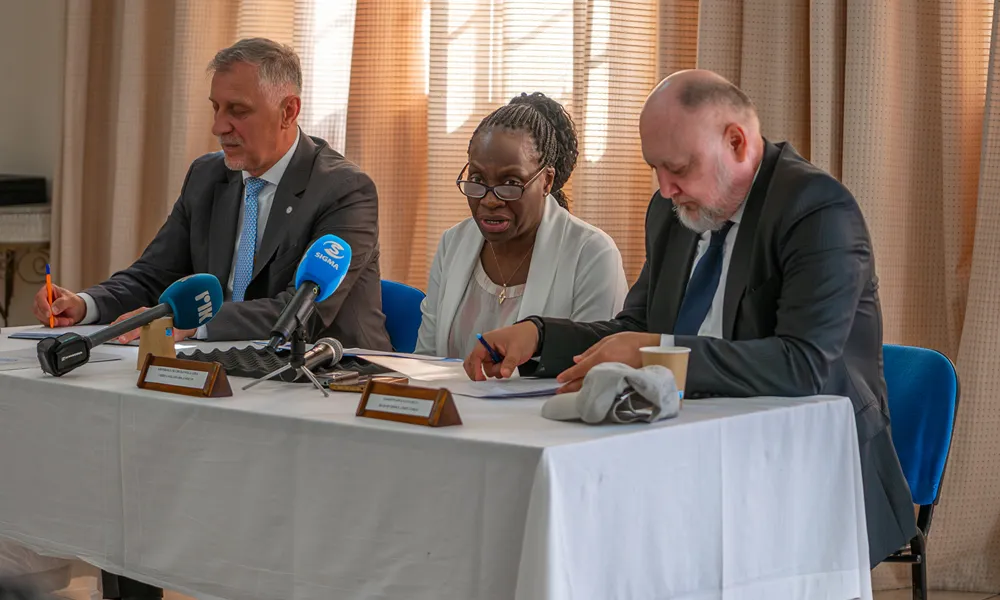
UN officials showcased a string of bi-communal initiatives underway across Cyprus and said activity on the Cyprus issue has “significantly” increased over the past two years, even as formal talks remain paused.
Opening a press briefing inside the buffer zone, UNFICYP spokesperson Aleem Siddique said the UN’s work is keeping people connected:
“Even without a political settlement, people are still coming together – across the divide… Every shared project is a step towards a more united and resilient island.”
Call to implement agreed measures
From the UN Good Offices Mission, Sergiy Illarionov stressed that recent engagement has accelerated: “There has been far more activity in the Cyprus issue in the past two years,” noting the Secretary-General’s continued personal involvement and the re-appointment of Personal Envoy María Ángela Holguín in May. At the same time, the Secretary-General has called on the parties to implement the agreed trust-building initiatives as soon as possible for the benefit of all Cypriots, he said.
Illarionov listed trust-building initiatives agreed in principle, including:
- creation of a Technical Committee on Youth;
- demining;
- environmental actions on climate change, micro-plastics and air quality;
- rehabilitation of cemeteries on both sides;
- exchange of art and artifacts;
- a consultative body for civil society;
- solar panels in the buffer zone to benefit both communities;
- and opening four more crossing points.
He cautioned delivery will “take persistence, some creativity, and most of all a willingness to compromise,” adding that the 13 Technical Committees – comprising nearly 50% women – are key to implementation. He highlighted past committee wins: interconnection of the electricity grids, mobile phone interoperability, and COVID-era vaccine transfers and harmonized crossing measures.
“Beyond these tangible results, the Committees have also served as vital channels of communication and dialogue,” he said.
Need for more inclusivity in the talks
Asked about the importance of inclusivity in the peace process, and efforts to have more voices heard, specifically with regard to the activation of the consultative body for civil society, Illarionov said the UN considers it a priority in many countries where it operates.
The UN welcomes the initiative and were “pleasantly surprised” when the two leaders agreed to set up the body, he said.
“We’ve been screaming and crying for the participation of women” in the peace process, he said, noting that their absence might be one of the reasons the process has not been successful so far.
However, implementation is a matter for the leaders to decide, and the UN can only offer its support, when they decide to move ahead on that.
EU doubling its budget for Turkish Cypriot community
UNDP Cyprus Head of Office Jakhongir Khaydarov detailed EU-funded projects translating dialogue into outcomes. “Our work is guided by a simple truth: sustainable development and peace go hand in hand,” he said.
Khaydarov noted the huge amount of work done so far, adding that much more can be done given the EU’s plans to double its financial assistance to the Turkish Cypriot community to over €60 million.
He highlighted key updates on the work of UNDP so far:
- Cultural Heritage Project: over 200 sites restored, conserved or preserved, with youth engagement through Youth Ambassadors and a Digital Heritage Platform.
- Local Infrastructure Facility: more than 20 projects since 2018, including seven major wastewater schemes, an 840 kW solar system at the Nicosia Wastewater Treatment Plant, social-environmental projects such as Kormakitis Centre for Cooperation, Kouklia Wetlands, and the upcoming Pedieos River restoration in Nicosia.
- Support Facility to Technical Committees: backing workshops, awareness campaigns and pilot projects across environment, culture and health to improve daily life and “build shared trust”.
Asked about the long-standing yet frozen plans to reuse treated wastewater from the waste treatment plant at Mia Milia, Khaydarov said the first phase has finally begun to start laying down the distribution network. However, final completion of the complex project may take up to five years, said Project Manager Alexandre Prieto.
Youth lead the way
From UNFICYP Civil Affairs, Abimbola Aina underlined island-wide people-to-people work aligned with UN Security Council Resolutions on Women, Youth, Peace and Security.
Aina highlighted that the flagship UN Youth Champions for Environment and Peace, now in its fifth year, has directly engaged 142 young leaders and 800+ participants, feeding into national conferences and advocacy for the new Youth Technical Committee.
Civil Affairs’ “Building Bridges” entrepreneurship theme has brought together 1,000+ businesspeople, while the Fashion Heritage Network Cyprus links young designers from both communities.
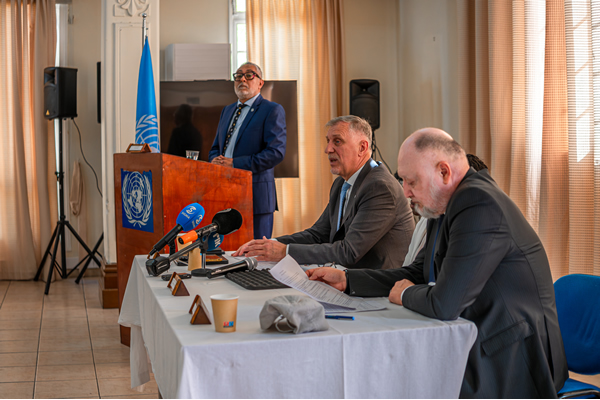
Illarionov emphasized impartiality and scope: the Good Offices Mission “treats both communities and their leaders equally in the context of the peace process,” and Wednesday’s briefing aimed “to explain… the role of the different missions and agencies… in facilitating contact between the two sides.”
Siddique framed the stakes simply: “They show that cooperation is possible, even when active negotiations are paused. And the trust built now will be key to any future agreement.”