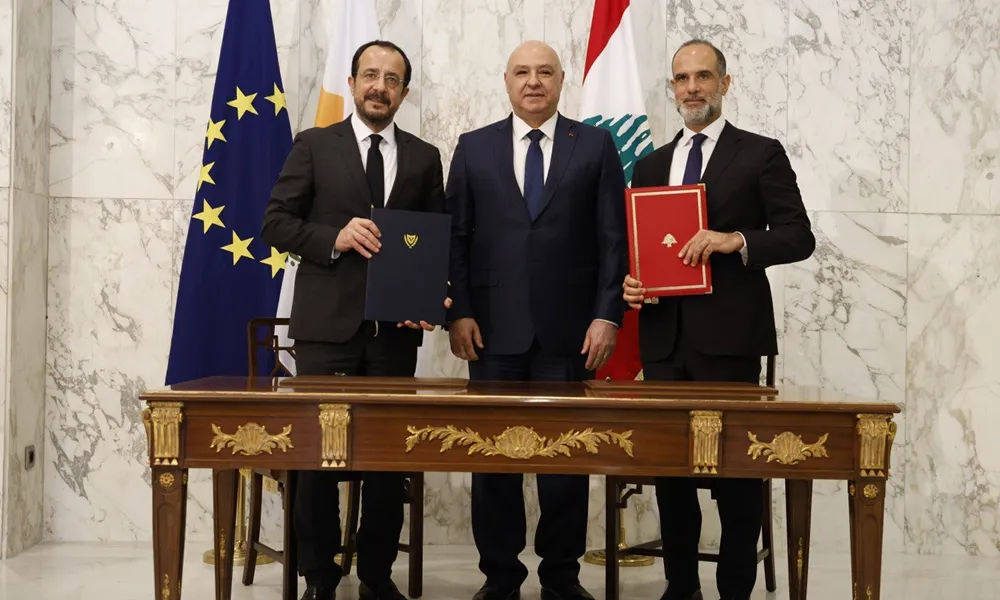
Cyprus and Lebanon signed a delimitation agreement on Wednesday on their respective Exclusive Economic Zones (EEZ), while launching efforts to connect their electricity grids through an underwater power cable.
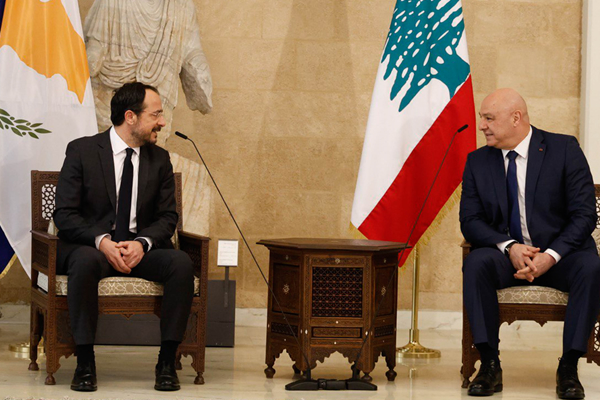
President Nikos Christodoulides met with his Lebanese counterpart President Joseph Aoun in Beirut to discuss a range of bilateral, regional and EU issues. After the meeting, Christodoulides and the Lebanese Minister of Public Works and Transport Fayez Rasamny signed the much-awaited EEZ agreement that determines the boundary between each country’s respective economic waters, based on the median line methodology.
The two presidents also agreed to explore the possibility of interconnecting their electricity grids through the creation of technical working groups and a World Bank-funded feasibility study.
Speaking after the signing, Christodoulides described the delimitation agreement as “a milestone of strategic significance that seals, in the clearest possible way, the level of our relations”.
He added: “We are sending a strong political message: that Cyprus and Lebanon, on the basis of international law, the relevant United Nations Convention on the Law of the Sea, and of course, good neighbourly relations, continue to invest in strengthening trust and mutual respect.”
A long time coming
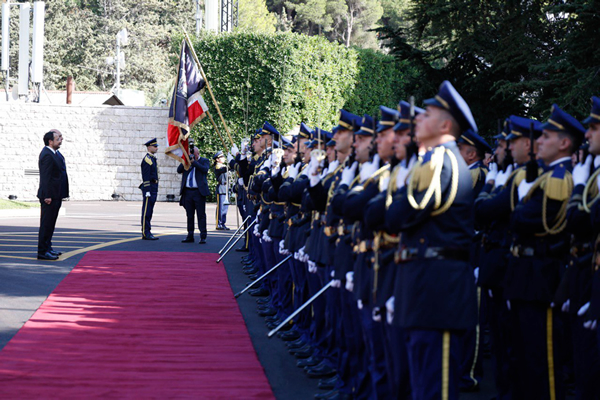
The “historic agreement” comes 18 years after the initial EEZ agreement between the two countries sat in limbo, waiting for Lebanese parliament ratification. Political factions within Lebanon feared that the 2010 Cyprus-Israel EEZ agreement had come at the cost of Lebanese maritime waters, bringing the issue to a standstill.
The region has seen tumultous changes since then. Despite the‘golden era’ of Cyprus-Israel relations, bilateral relations with Lebanon are also enjoying their moment in the sun. Cyprus and Lebanon collaborate closely on migration issues and coordinate to ensure the EU pays adequate attention to its southeastern neighbour, particularly with much needed financial assistance.
Recently, Lebanon made it a priority to secure consistent power generation to stabilise the economy, as well as to create a predictable legal environment that would attract major energy companies to explore for offshore hydrocarbons.
With Aoun’s election in January 2025, Christodoulides was the first foreign leader to visit him. Negotiations with Cyprus on a revised delimitation agreement intensified soon after, and by October, a final draft of the EEZ agreement received cabinet approval by both governments.
Earlier this month, the Lebanese Minister of Energy and Water Joe Saddi took the short flight to Cyprus to discuss the prospect of exchanging technical know-how on energy autonomy and exploring the prospect of electricity interconnection.
Following Wednesday’s’ EEZ signing, it is believed Aoun will not need to send the agreement to parliament for ratification, following the 2022 precedent when the Lebanese President adopted via decree an informal, US-brokered maritime boundary agreement with Israel.
The next step should be a unitisation or joint exploitation agreement to deal with potential gas reserves found on the maritime border between the two countries. A similar issue in Cyprus’ Block 12, bordering Israeli waters, has been a consistent thorn in the side of exploitation efforts for the Aphrodite gas discovery.
Opening door to exploration
“We are closing a long-pending issue of many years and now looking to the future and to what our countries can jointly build on this foundation,” said Christodoulides.
He thanked Aoun for his political will and determination, as well as the contribution of Prime Minister Nawaf Salam towards reaching agreement, along with the “tireless” work of negotiating heads, Lebanon’s Rasamny and Cyprus’ National Security Advisor Tasos Tzionis.
For his part, speaking through an interpreter, President Aoun said the delineation agreement will allow both countries to explore their respective maritime resources and foster bilateral collaboration.
“We can now work on developing bilateral agreements thereby facilitating and enhancing the work of exploration companies in both our countries,” he said.
Message to neighbours
In a clear message to regional neighbours, possibly Syria and Turkey, Aoun said: "Our cooperation targets no one, nor does it exclude anyone. It is not meant to block the way of any friend or partner. On the contrary, we want this agreement to become the cornerstone of an international cooperation we wish to extend to our whole region, to provide stability and prosperity for all our countries and peoples."
The Lebanese president issued a call for all parties seeking cooperation and the wellbeing of their citizens to pursue a maritime understanding.
“We believe this is the only way to put an end to violence, wars, and policies of hegemonial greed which came at a very high cost to our region and its people.”
Potential for energy cooperation
Speaking at the Baabda Presidential Palace, Christodoulides said the agreement enhances the prospects for cooperation in energy and infrastructure, while providing legal and economic certainty for potential investors. It also strengthens the region’s potential to act as an alternative energy corridor for Europe, he said, describing the agreement as a “strategic foundation for regional stability and security in our particularly complex region.”
Aoun highlighted the potential to proceed with new joint projects in energy, particularly renewable energy, as well as telecommunications and transmission lines, and in tourism. He noted the continued collaboration in joint defence and security.
Electricty interconnction
The two presidents also welcomed the dialogue begun on the Cyprus-Lebanon electricity interconnection. Christodoulides announced that on Wednesday, “Cyprus and Lebanon jointly addressed the World Bank for the preparation of the relevant feasibility study for the specific project.”
Meanwhile, work on the undersea telecommunications cable CADMOS-2 is underway, with plans to lay the cable in early 2026.
Lebanon–EU Relations
The two leaders also discused broader energy issues, expanding bilateral cooperation, regional developments and Lebanon-EU relations. Christodoulides welcomed Aoun’s determination to bring Lebanon and its people into “a new, much better era,” adding that “Cyprus remains your most stable, reliable and predictable partner in this great effort.”
He expressed support for Lebanon’s independence, sovereignty and territorial integrity, and for the full implementation, by all parties, of the relevant UN Security Council Resolutions regarding UNIFIL. The Cypriot president said Cyprus’ EU Presidency in the first half of 2026 to serve as “a channel of communication and a vehicle of meaningful cooperation between Lebanon and the EU”.
Aoun echoed the view that Cyprus’ EU Presidency can intensify "engagement and cooperation with Europe,” and set as a key target the signing of the Lebanon-EU strategic partnership during Cyprus’ EU Presidency.
He also referred to projects of common interest, and Lebanon’s commitment to countering illegal migration in the Mediterranean, noting the need for the means “to carry out and sustain this vital mission for the security of Europe and our sovereignty".